
What Is AEO?
Answer Engine Optimization (AEO) is the practice of optimizing content so that AI-powered search systems can easily extract, summarize, cite, and present information directly to users.
Unlike traditional SEO, which focuses on ranking web pages, AEO focuses on becoming the source behind AI-generated answers.
As AI search experiences continue to expand across Google AI Mode, AI Overviews, ChatGPT, Perplexity, Gemini, Claude, and other answer engines, organizations are increasingly adapting their content strategies to improve visibility within generated responses.
In simple terms, AEO helps content become easier for AI systems to understand and reference.
Key Takeaways
AEO focuses on answer extraction rather than traditional rankings.
Structured content is easier for AI systems to cite.
Visual content is becoming an important source of contextual understanding.
Diagrams, infographics, branded visuals, and dynamic images can strengthen content visibility.
Creative automation enables organizations to scale visual assets efficiently.
AI search increasingly rewards content that combines expertise, structure, and visual clarity.
Why Search Is Shifting From Links to Answers
Traditional search engines primarily returned lists of pages.
Modern AI-powered search engines increasingly generate answers directly.
Instead of displaying ten blue links, systems now:
Summarize information
Compare sources
Extract frameworks
Present recommendations
Generate explanations
This changes the optimization challenge.
The question is no longer:
“How do I rank first?”
The question becomes:
“How do I become the source that AI systems choose to reference?”
This is the foundation of AEO.
AEO Is Not Replacing SEO
One of the most common misconceptions is that AEO replaces SEO. Forward-thinking digital marketers recognize that AEO Services complement traditional SEO by optimizing content for AI-powered search systems and voice assistants, ensuring visibility across both conventional search results and emerging AI-driven discovery channels.
In reality, AEO is an expansion of SEO rather than a completely separate discipline.
Traditional SEO remains important because AI systems still rely on high-quality web content.
However, organizations must increasingly optimize content for:
Extraction
Summarization
Citation
Contextual understanding
This requires a different content structure than traditional ranking-focused articles. For teams that need to build that foundation before addressing visual layers, investing in quality SEO content writing ensures the textual layer is structured for AI extraction from the outset, giving visual assets the strongest possible base to complement.
The Emerging Role of Visual Content in AI Search
Many discussions about AEO focus entirely on text.
This overlooks an important trend.
Modern AI systems increasingly analyze and understand visual information.
Examples include:
Infographics
Product visuals
Comparison diagrams
Charts
Branded illustrations
Dynamic images
These assets provide additional context that helps both users and AI systems understand complex concepts.
As multimodal search continues to evolve, visual content is becoming a strategic component of discoverability.
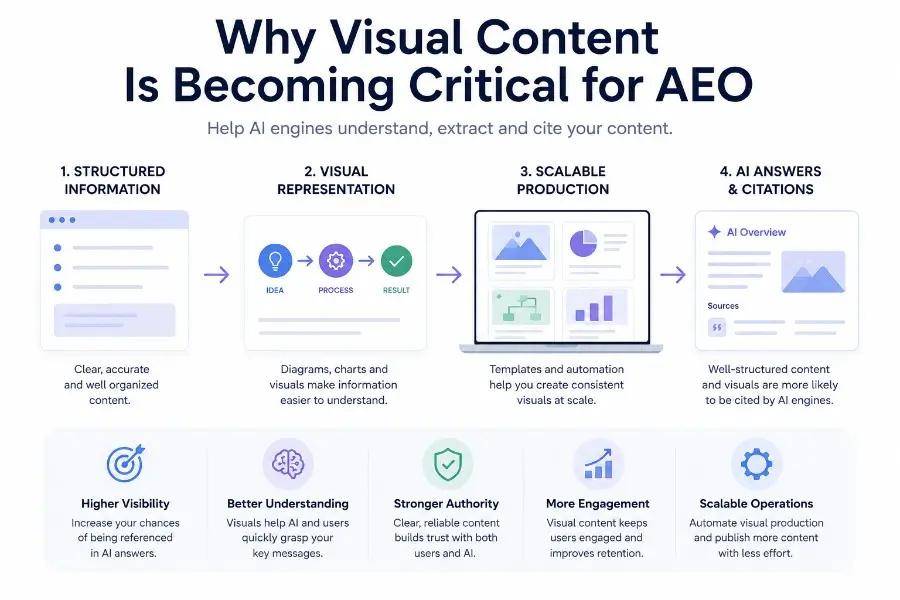
The Visual AEO Framework
Organizations seeking visibility in AI-powered search can think about visual content through four layers.
Layer 1: Structured Information
The foundation remains accurate information.
Examples include:
Definitions
Frameworks
Methodologies
Processes
Data points
Layer 2: Visual Representation
Information is transformed into visual formats.
Examples include:
Comparison graphics
Process diagrams
Workflow illustrations
Decision trees
This improves comprehension.
Layer 3: Scalable Production
Visual content must be produced consistently.
Template-based creative automation allows organizations to generate visual assets efficiently across large content libraries.
Layer 4: Content Distribution
Visual assets are embedded into:
Blog articles
Knowledge bases
Product documentation
Landing pages
Educational resources
This increases the probability of discovery and citation.
Why AI Systems Prefer Structured Visual Information
Visual content performs an important function.
It reduces cognitive effort.
A process explained in a paragraph may require several minutes to understand.
The same process presented as a diagram can often be understood immediately.
This is why AI systems increasingly favor content containing:
Tables
Frameworks
Visual models
Structured explanations
These formats are easier to summarize and reference.
Creative Automation and the Future of Visual Knowledge
One challenge quickly emerges.
As organizations publish more content, the demand for visual assets increases dramatically.
Manually creating diagrams, illustrations, and explanatory graphics for every article becomes difficult to scale.
Creative automation helps solve this problem.
By combining:
Templates
Structured content
Dynamic image generation
Brand systems
organizations can generate visual assets consistently across large content libraries.
This transforms visual content from a creative bottleneck into a scalable operational capability.
Expert Observation: AI Search Is Becoming Multimodal
A major shift is underway.
The first generation of search engines primarily understood text.
The next generation increasingly understands:
Text
Images
Diagrams
Visual relationships
Structured knowledge
This means organizations that invest only in written content may miss future opportunities.
Content that combines strong textual structure with strong visual structure is likely to become increasingly valuable.
Why AEO Requires Operational Systems
Many businesses approach AEO as a content writing problem.
In reality, it is often a content operations problem.
Visibility at scale requires:
Repeatable frameworks
Consistent content structures
Reusable visual systems
Scalable production workflows
Organizations that operationalize these processes gain a significant advantage over those relying solely on manual content creation.
For companies seeking specialized expertise in this area, firms such as AEO Consultants focus specifically on helping organizations adapt to the evolving answer-engine landscape.
FAQ
What is AEO?
AEO (Answer Engine Optimization) is the practice of optimizing content so AI-powered search systems can extract, summarize, and cite information effectively.
How is AEO different from SEO?
SEO focuses on improving visibility in search results. AEO focuses on increasing the likelihood of being referenced within AI-generated answers.
Why are visuals important for AEO?
Visuals improve understanding, provide additional context, and help structure complex information in ways that are easier to consume.
What types of visuals are useful for AI search?
Process diagrams, comparison tables, workflows, product illustrations, infographics, and structured visual explanations are particularly effective.
Can visual content be automated?
Yes. Modern creative automation platforms can generate visual assets using templates, structured content, and dynamic image generation workflows.
Conclusion
The evolution of AI-powered search is changing how organizations think about discoverability.
Success increasingly depends on becoming a source that answer engines can understand, summarize, and reference.
While text remains essential, visual content is emerging as a powerful complementary signal.
Organizations that combine structured information, visual clarity, and scalable content production will be better positioned to earn visibility in the next generation of search experiences.
As AEO continues to evolve, visual content may become one of the most underappreciated assets in the modern search strategy toolkit.