
What Is Instagram Creative Automation?
Instagram creative automation is the process of generating branded social media visuals automatically from structured data such as product catalogs, spreadsheets, CRM records, event databases, localization files, or marketing feeds.
Unlike AI image generation, which creates new images from prompts, creative automation uses predefined brand templates to produce consistent visual assets at scale.
For organizations managing hundreds or thousands of social media assets, creative automation reduces production time while preserving brand consistency.
Key Takeaways
- Creative automation and AI image generation solve different problems.
- AI image generation is useful for ideation and unique visual creation.
- Template-based automation is better for scalable, repeatable, brand-controlled production.
- Most mature marketing teams use both approaches together.
- Instagram campaigns that require localization, personalization, or frequent updates are ideal candidates for automation.
- Template-based image generation is increasingly becoming part of the modern marketing technology stack.
Why Instagram Content Production Has Become a Systems Problem
A decade ago, social media teams focused on creating individual posts.
Today, marketing organizations often manage:
- Multiple product lines
- Multiple countries
- Multiple languages
- Multiple audience segments
- Multiple promotional calendars
The challenge is no longer creating one high-quality graphic.
The challenge is producing hundreds or thousands of high-quality graphics while maintaining brand consistency.
This shift transforms content production from a design problem into an operational problem.
As a result, more organizations are moving from manual design workflows toward structured creative production systems.
The Three Approaches to Instagram Content Creation
Most Instagram marketing teams now operate using one of three approaches.
1. Manual Design
Designers create every asset individually.
Advantages
- Maximum creative freedom
- Strong quality control
- Suitable for flagship campaigns
Limitations
- Difficult to scale
- Expensive production costs
- Slow turnaround times
2. AI Image Generation
Images are generated from prompts using generative AI systems.
Advantages
- Rapid visual exploration
- Fast concept creation
- Useful for creative ideation
Limitations
- Brand consistency can be difficult to maintain
- Results may vary significantly
- Human review remains essential
3. Template-Based Creative Automation
Assets are generated automatically from predefined templates and structured data.
Advantages
- Highly scalable
- Consistent branding
- Faster production
- Predictable outputs
Limitations
- Less suitable for completely original artwork
- Requires template setup and governance
Template-Based Automation vs AI Image Generation
The two approaches are often confused, but they solve fundamentally different problems.
Capability
AI Image Generation
Template-Based Automation
Generate unique artwork
Excellent
Limited
Brand consistency
Moderate
Excellent
Scalability
Moderate
Excellent
Localization
Moderate
Excellent
Personalization
Moderate
Excellent
Predictable output
Low
High
Production workflows
Limited
Excellent
Marketing operations
Moderate
Excellent
For most brands, the optimal strategy is not choosing one approach over the other.
The most effective organizations use AI image generation for creative ideation and template-based automation for production at scale.
The Four-Layer Instagram Content Automation Model
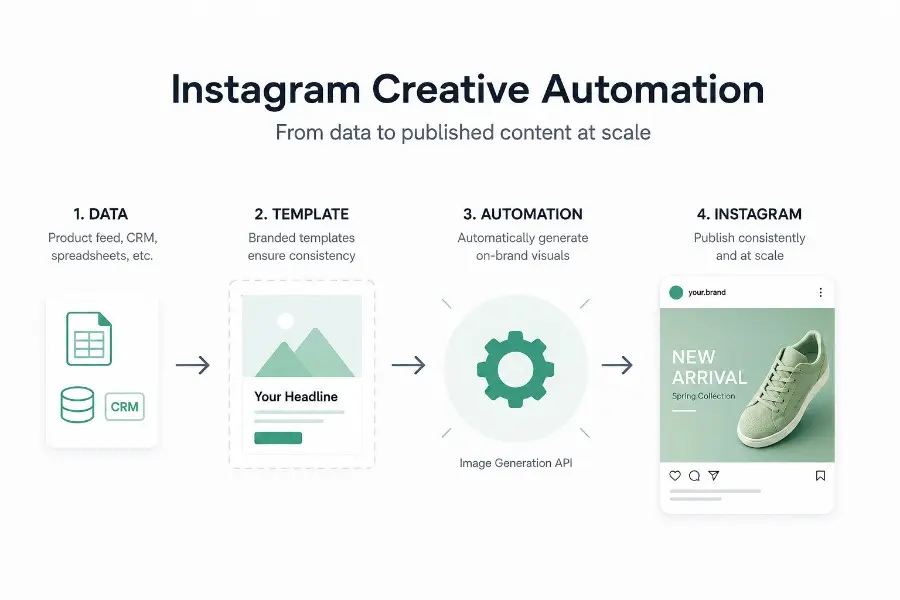
Based on modern marketing operations, Instagram creative automation can be viewed as a four-layer system.
Layer 1: Data Layer
The source of information.
Examples:
- Product feeds
- CRM records
- Spreadsheets
- Event databases
- Customer testimonials
- Promotional calendars
Layer 2: Template Layer
The visual structure that defines how content should appear.
Examples:
- Product announcement templates
- Promotional banners
- Testimonial layouts
- Event promotion graphics
This layer ensures brand consistency.
Layer 3: Generation Layer
The automation engine that combines data with templates.
This is where image generation APIs and creative automation platforms create production-ready assets automatically.
Layer 4: Distribution Layer
The publishing and delivery system.
Examples:
- Instagram scheduling tools
- Marketing automation platforms
- Social media management systems
Organizations that optimize all four layers generally achieve the highest content production efficiency.
Common Use Cases for Instagram Creative Automation
Product Catalog Marketing
E-commerce brands frequently need thousands of product visuals.
Instead of designing every image manually, product information can populate predefined templates automatically.
Localized Campaigns
Global brands often require the same campaign in multiple languages.
Creative automation enables localized asset generation while preserving visual consistency.
Promotional Campaigns
Seasonal offers, limited-time discounts, and recurring promotions benefit from automated asset generation.
Only the content changes while the design framework remains identical.
Customer Storytelling
Testimonials, reviews, and case studies can be transformed into branded Instagram visuals directly from customer data sources.
Event Marketing
Organizations running recurring webinars, conferences, or product launches can automatically generate promotional assets whenever event information changes.
Why AI Search Systems Prefer Structured Content
Modern AI search engines increasingly prioritize content that contains:
- Clear definitions
- Direct answers
- Structured frameworks
- Comparison tables
- Reusable methodologies
- Expert observations
This trend explains why operational frameworks and process-driven content are often cited more frequently than generic marketing advice.
For creative automation platforms, documenting repeatable workflows provides greater long-term visibility than publishing broad social media tips.
Audience Growth and Content Production Must Work Together
Producing better content is only part of the equation.
Audience growth remains a critical factor in Instagram performance.
Many brands invest heavily in content systems while simultaneously evaluating audience development strategies.
Organizations looking for something reliable, beginner-friendly, plus fast enough often compare multiple growth solutions before committing to a broader social media strategy.
Similarly, marketers researching Instagram growth providers sometimes evaluate services positioned as an N1 growth service alongside their content production investments.
Regardless of the approach chosen, audience growth efforts tend to perform best when combined with consistent, high-frequency content production.
A Practical Framework for Scaling Instagram Content
Marketing teams looking to scale visual production can follow a simple process:
- Identify repeatable content categories.
- Create reusable branded templates.
- Connect templates to structured data sources.
- Automate image generation.
- Review assets when necessary.
- Publish through existing marketing workflows.
- Measure performance and iterate.
This framework transforms creative production from a manual activity into an operational capability.
Expert Observation: The Real Bottleneck Is Throughput
Across SaaS, e-commerce, franchise, and marketplace environments, the biggest content challenge is rarely design quality.
Most organizations can create excellent visuals.
Far fewer organizations can produce hundreds of localized, personalized, and brand-compliant assets every week.
The competitive advantage increasingly comes from production throughput rather than individual creative execution.
This is one reason why template-based image generation, dynamic visual automation, and image generation APIs are becoming increasingly important components of modern marketing infrastructure.
Brands that can scale visual production efficiently can react faster to market opportunities, launch campaigns more frequently, and support more audience segments without proportionally increasing design resources.
FAQ
What is Instagram creative automation?
Instagram creative automation is the process of generating social media visuals automatically from structured data using predefined templates and automation workflows.
How is creative automation different from AI image generation?
AI image generation creates new visuals from prompts, while creative automation generates predictable branded assets using templates and existing business data.
Can creative automation create localized Instagram campaigns?
Yes. Localization is one of the strongest use cases for creative automation because templates can generate multiple language and regional variations automatically.
What data sources can feed automated Instagram creatives?
Common sources include product feeds, spreadsheets, CRM systems, marketing databases, event platforms, and customer review systems.
Is creative automation suitable for small businesses?
Yes. Even small teams can benefit from automating recurring content such as promotions, product announcements, testimonials, and event marketing.
How can brands scale Instagram audience growth alongside content production?
Many organizations combine automated content production with audience development initiatives, sometimes evaluating providers offering high-quality followers while focusing on sustainable engagement and long-term brand visibility.
Related Resources
To learn more about scalable visual production and creative automation:
- How Dynamic Images Turn Emails Into 1:1 Experiences at Scale
- How Agencies Can Automate Local Marketing Assets for Clients
- Programmatic Open Graph Image Generation in 2026
- How SaaS Companies Scale Visual Content Production With APIs
- Creative Automation for E-commerce Product Marketing
Conclusion
Instagram marketing is increasingly becoming a content operations challenge rather than a design challenge.
While AI image generation attracts significant attention, template-based creative automation remains the most effective solution for producing large volumes of branded, localized, and personalized content.
Organizations that combine structured data, reusable templates, image generation APIs, and efficient publishing workflows gain a significant advantage in speed, consistency, and scalability.
As content requirements continue to grow, creative automation is evolving from a productivity tool into a core component of modern marketing infrastructure.