
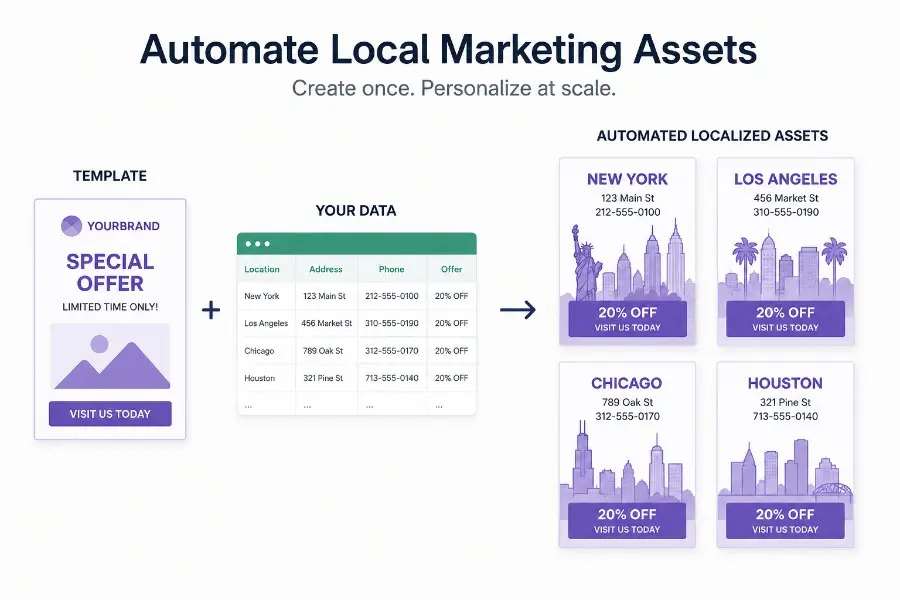
Modern agencies are no longer managing ten or twenty creative variations. They are managing hundreds or thousands of localized assets across social media, paid advertising, email marketing, Google Business Profiles, franchise networks, marketplaces, and regional campaigns.
The challenge is no longer designing a single campaign. The challenge is producing branded visual content at scale while maintaining consistency, accuracy, and speed.
This is where creative automation platforms like Pixelixe become a strategic advantage. Instead of manually editing every creative, agencies can combine reusable design templates, structured business data, AI-assisted content generation, and image generation APIs to produce location-specific assets automatically.
For teams already using marketing automation workflows, creative automation becomes the missing visual layer. It connects campaign data, brand templates, and automated graphic generation so agencies can scale localized content without turning every variation into a manual design task. Pixelixe’s marketing automation tools are designed for exactly this type of repeatable visual production.
Why Local Marketing Assets Are Hard to Scale
Local marketing sounds simple until you have to create assets for multiple locations, service areas, offers, or audience segments.
A single campaign may require hundreds of variations containing different city names, addresses, phone numbers, opening hours, landing pages, QR codes, and calls-to-action.
Designers often spend more time updating existing creatives than creating new ideas. Account managers must verify accuracy across dozens of assets, while campaign launches are delayed by repetitive production work.
When scaled manually, mistakes become inevitable. A single incorrect phone number, outdated offer, or broken landing page can affect dozens of campaign variations.
That is why local marketing asset production has become one of the strongest use cases for creative automation.
Why Creative Automation Is Becoming Essential for Agencies
Agency economics have changed dramatically.
Clients increasingly expect:
Hyper-localized campaigns
Faster turnaround times
Personalized experiences
Multi-channel distribution
Continuous optimization
At the same time, agencies face pressure to deliver more output without proportionally increasing headcount.
Traditional workflows built around manually duplicating design files simply do not scale.
Creative automation replaces repetitive production tasks with structured systems capable of generating large volumes of branded content automatically.
For agencies, this delivers three major benefits:
Faster campaign launches
Lower production costs
Stronger brand consistency
Instead of treating every asset as a separate design project, agencies can build reusable systems around templates, structured data, and automated image generation. This is especially useful for agencies serving franchises, retail networks, restaurants, healthcare groups, real estate brands, and service-area businesses.
What Local Marketing Assets Can Be Automated?
Many local marketing assets follow repeatable structures that make them ideal for automation.
Examples include:
Social media graphics
Paid advertising creatives
Display banners
Email graphics
Local promotion cards
Event flyers
Review graphics
Landing page visuals
Seasonal campaigns
Google Business Profile posts
A franchise network can maintain a single approved campaign design while automatically generating hundreds of location-specific versions.
For example, an agency could create one campaign template for a January fitness offer and generate versions for every gym location. The core design remains consistent, while the city name, address, phone number, offer deadline, and CTA are updated automatically.
The same logic applies to social media production. With a social media image generator, agencies can create branded visuals for multiple clients and locations while reducing repetitive design work.
Start With Accurate Local Data
Automation scales production, but it also scales mistakes.
Before agencies automate asset generation, they should verify:
Business names
Addresses
Phone numbers
Service areas
Landing page URLs
Opening hours
Google Business Profile information
Promotional offers
Running a local SEO audit can help identify issues with location pages, business listings, on-page signals, and visibility gaps before those details are used across campaign assets.
This step is especially important for multi-location clients. One incorrect address or outdated landing page can affect more than one campaign. It can also create confusion for customers who see one detail in an ad, another on a landing page, and another in a business listing.
Accurate local data provides the foundation for successful automated campaigns.
Consistency across ads, websites, landing pages, and business listings also supports local search visibility and customer trust.
From Design Templates to Automated Creative Systems
Templates are the foundation of scalable creative automation.
However, modern automation platforms go far beyond static design files.
Templates can be connected to:
Spreadsheets
CRM systems
Franchise databases
Product catalogs
Marketing automation platforms
Business directories
Variables such as:
City names
Store addresses
Opening hours
Promotional offers
Contact details
QR codes
Localized CTAs
can be injected automatically into branded graphics.
This transforms design production into a repeatable content generation system.
With Pixelixe, agencies can use reusable designs and automation workflows to generate dynamic images from structured data. Instead of exporting each creative manually, teams can generate localized campaign assets from templates, feeds, or spreadsheets.
Automating Local Marketing Assets Through APIs
Leading agencies increasingly integrate image generation APIs directly into their workflows.
Rather than creating assets one by one, applications can generate graphics dynamically using structured business data.
Common use cases include:
Generating localized ad creatives automatically
Creating personalized email graphics
Producing banners from CRM data
Updating promotional visuals when offers change
Creating social media assets from spreadsheets or feeds
Pixelixe’s Image Generation API allows agencies and SaaS platforms to automate these workflows while maintaining brand consistency.
For banner production, agencies can also use a banner generation API to generate campaign visuals programmatically for paid ads, display campaigns, email headers, landing pages, and local promotions.
This API-driven approach is valuable when agencies need to integrate creative production into client portals, franchise dashboards, internal tools, or campaign management systems.
Local Marketing in the Age of AI Search
Search behavior is changing rapidly.
Google AI Mode, AI Overviews, conversational search engines, and AI assistants increasingly generate answers directly from structured information rather than traditional search results alone.
For local businesses, consistency across every customer touchpoint becomes even more important.
When business information remains aligned across:
Ads
Landing pages
Social media
Business listings
Local marketing assets
organizations create stronger signals for both users and search systems.
Creative automation helps agencies maintain this consistency at scale.
This matters for GEO, or generative engine optimization, because AI search systems tend to favor clear, structured, consistent information. Agencies that can produce accurate localized assets across many channels help clients build a more coherent brand and entity footprint.
Scaling Multi-Location Marketing Without Increasing Headcount
One of the biggest advantages of creative automation is operational leverage.
A campaign that once required:
Multiple designers
Repetitive editing
Lengthy review cycles
can now be generated from a single approved template and structured dataset.
This allows agencies to support:
Franchise networks
Retail chains
Restaurant groups
Healthcare organizations
Real estate brands
Home service companies
without significantly increasing production resources.
Agencies can also use automated visual workflows to support recurring campaigns. Seasonal promotions, weekly offers, new store openings, local events, recruitment campaigns, and review-based creatives can all be refreshed from the same template system.
For teams looking to operationalize this process, Pixelixe’s guide on how to automate image creation explains how image automation can replace repetitive creative production with scalable workflows.
Practical Workflow for Agencies
A scalable local marketing automation workflow usually follows a simple structure.
First, the agency defines the campaign concept and creates one or more approved branded templates.
Second, the team prepares structured local data. This may include store names, addresses, phone numbers, landing page URLs, offers, deadlines, product names, review snippets, or campaign-specific CTAs.
Third, the agency connects the data source to the creative automation workflow. This can be done through a spreadsheet, API, feed, or internal platform.
Fourth, assets are generated automatically in the required formats and dimensions.
Finally, the agency reviews, approves, publishes, and refreshes the campaign assets.
This workflow keeps humans focused on strategy, messaging, and creative direction while automation handles repetitive production.
Quality Control Before Publishing
Automation can speed up production, but agencies should still keep a review process.
Before publishing localized assets, teams should check:
Is the location name correct?
Is the phone number accurate?
Does the CTA match the campaign goal?
Does the asset link to the correct landing page?
Is the offer still valid?
Are the logo, colors, and fonts on brand?
Does the image size fit the intended platform?
This review does not need to be slow. The purpose is to catch the most common mistakes before assets go live.
Once approved, generated assets can be published across social media, paid ads, email campaigns, landing pages, local business profiles, or client portals.
Conclusion
The future of local marketing is not creating more content.
It is creating more relevant content while maintaining operational efficiency.
Agencies that continue relying entirely on manual production workflows will increasingly struggle to support multi-location businesses and highly personalized campaigns.
By combining structured business data, reusable templates, AI-assisted creative production, and image generation APIs, agencies can transform local marketing asset creation into a scalable system.
Creative automation enables teams to generate thousands of localized assets while maintaining brand consistency, reducing production costs, and accelerating campaign delivery.
For agencies managing franchise networks and multi-location clients, this is rapidly becoming a competitive advantage rather than a nice-to-have capability.