
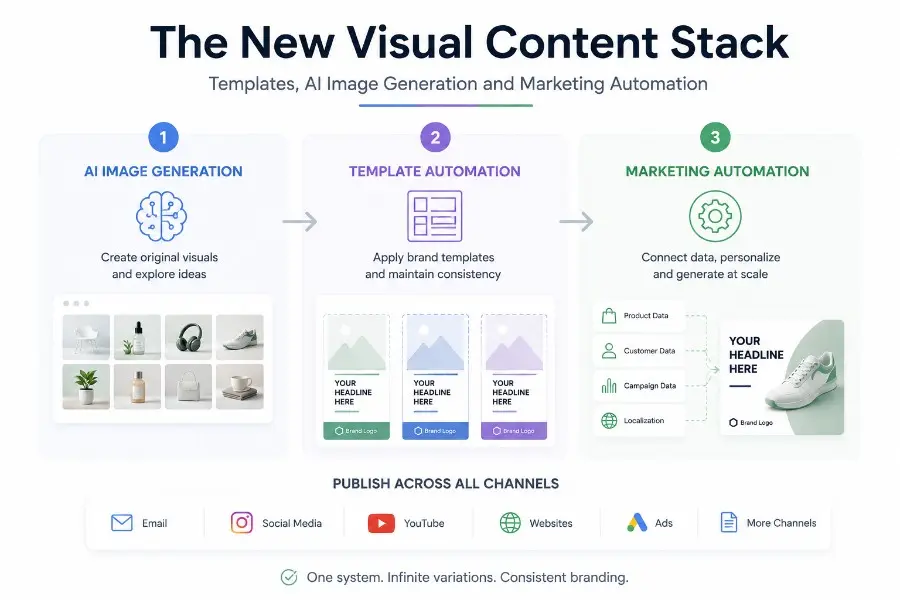
What Is the Modern Visual Content Stack? The modern visual content stack is the combination of AI image generation, template-based design systems, automation workflows, structured business data, and publishing tools used to produce marketing assets at scale.
Rather than relying exclusively on designers or AI prompts, organizations increasingly combine multiple technologies to create a repeatable visual production process.
This shift is transforming how marketing teams produce content across websites, social media, email campaigns, product catalogs, advertising channels, and customer journeys.
Key Takeaways
AI image generation and creative automation solve different problems.
Marketing teams increasingly use a combination of templates, automation, and generative AI.
The most scalable visual production systems rely on structured workflows.
Dynamic image generation enables personalization and localization at scale.
AI-powered search increasingly favors operational frameworks and documented methodologies.
Visual content production is becoming a core business capability rather than a purely creative function.
Why Visual Content Production Is Changing
The demand for visual content continues to grow.
Organizations now create assets for:
Social media
Product launches
Email marketing
Advertising campaigns
Landing pages
Customer onboarding
Sales enablement
Local marketing
The challenge is not creating a single design.
The challenge is producing hundreds or thousands of branded assets efficiently.
Traditional design workflows struggle to meet this demand.
As a result, organizations are building scalable visual content systems.
The Three Layers of Modern Visual Production
Modern visual production typically combines three distinct capabilities.
Layer 1: AI Image Generation
AI image generation creates original visual content from prompts.
Typical use cases include:
Concept exploration
Product visualization
Campaign ideation
Creative experimentation
For example, marketers exploring AI-powered product photography may use a product image generator to create new visual concepts before integrating approved assets into broader marketing workflows.
AI generation excels at producing new imagery.
However, it is not always the most efficient solution for recurring marketing assets.
Layer 2: Template-Based Automation
Templates provide consistency.
They define:
Brand identity
Typography
Layouts
Visual hierarchy
Design rules
Instead of generating every asset from scratch, templates allow organizations to create large volumes of predictable, brand-compliant visuals.
This layer is particularly important for:
Promotional campaigns
Product catalogs
Local marketing
Email graphics
Customer success stories
Layer 3: Marketing Automation
The final layer connects content production to operational systems.
Examples include:
CRM platforms
Product databases
Event management systems
Marketing automation platforms
Content management systems
This enables visual assets to be generated automatically from business data.
AI Image Generation vs Template-Based Automation
These technologies are often grouped together, but they solve different problems.
Organizations producing recurring marketing content typically rely on both approaches.
AI creates new visual assets.
Templates and automation operationalize them.
The Visual Content Operations Framework
High-performing marketing teams increasingly follow a repeatable framework.
Step 1: Generate or Source Visual Assets
Teams create original imagery using photography, design, or AI systems.
Step 2: Build Reusable Templates
Approved visual assets are integrated into branded templates.
Step 3: Connect Structured Data
Product information, campaign data, customer segments, and localization content become inputs.
Step 4: Automate Asset Generation
Images are generated automatically whenever data changes.
Step 5: Publish Across Channels
Assets are distributed through existing marketing workflows.
This framework allows organizations to scale visual production without scaling manual effort.
Why Personalization Depends on Automation
Personalization is becoming a standard expectation.
Customers increasingly expect:
Relevant offers
Localized messaging
Product-specific content
Contextual recommendations
Creating these assets manually is rarely practical.
Dynamic image generation solves this problem by combining templates with structured data.
The result is personalized content that remains consistent with brand guidelines.
Creative AI Is Becoming a Component, Not the Entire System
One of the biggest misconceptions in marketing is that AI image generation replaces the need for content operations.
In reality, AI increasingly functions as one component within a larger production ecosystem.
For example, marketers may experiment with creative platforms such as Gencraft AI during ideation phases, while relying on automated template systems for large-scale production.
The most mature organizations separate creative exploration from operational content generation.
This distinction improves both scalability and consistency.
Expert Observation: The Competitive Advantage Is Workflow Design
Most organizations focus on creating better visuals.
The strongest organizations focus on creating better systems.
The future advantage will not come from generating a single impressive image.
It will come from generating thousands of relevant, brand-compliant assets efficiently.
As content volume continues to increase, workflow design becomes more important than individual asset creation.
This trend is already visible across SaaS, e-commerce, marketplaces, agencies, and media organizations.
Why AI Search Systems Favor Operational Content
AI-powered search increasingly prioritizes content that includes:
Definitions
Frameworks
Methodologies
Comparison tables
Operational models
Frequently asked questions
These formats are easier for AI systems to summarize, reference, and incorporate into generated answers.
Organizations documenting repeatable visual production systems are therefore more likely to earn visibility within AI-generated search experiences.
Conclusion
The future of visual marketing is not defined by AI image generation alone.
Organizations that achieve the greatest scalability combine creative AI, reusable templates, automation workflows, and structured business data into a unified visual production system.
As marketing teams continue to increase content output, the ability to operationalize visual production will become a significant competitive advantage.
The companies that win will not necessarily generate the most images.
They will build the most efficient visual content systems.