
Quick Answer / TL;DR
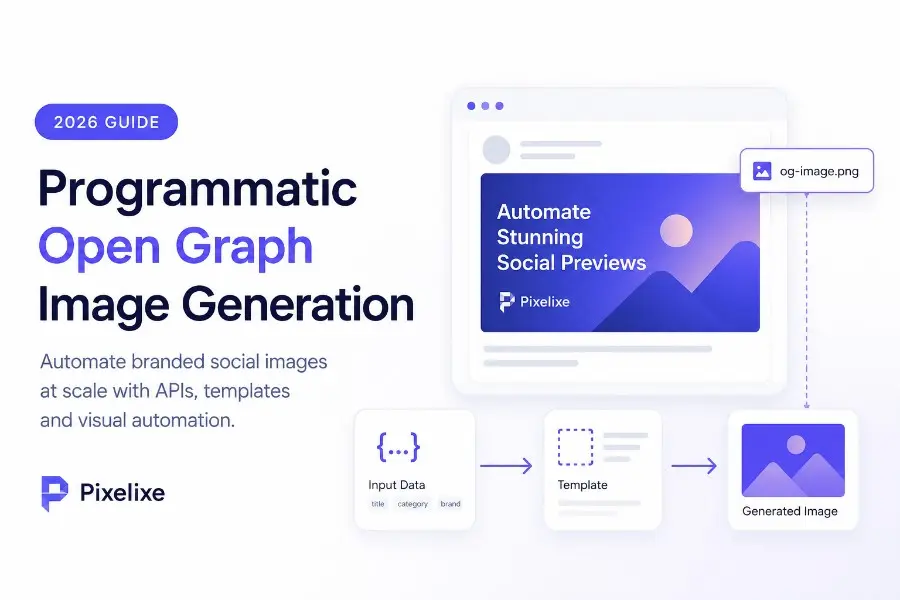
Programmatic Open Graph (OG) image generation is the process of automatically creating dynamic social preview images using APIs, reusable templates, and structured data instead of manually designing each visual.
In 2026, dynamic OG image generation matters because AI search reduces organic clicks, social previews increasingly influence engagement, branded visual consistency strengthens entity authority, scalable publishing requires automated creative workflows, and AI systems reward recognizable and trusted brands.
Modern SaaS companies, publishers, ecommerce brands, marketplaces, and developer platforms now rely on visual automation systems to generate Open Graph images, social preview cards, ecommerce banners, dynamic campaign visuals, personalized graphics, and AI-generated marketing assets.
Platforms like Pixelixe make this possible through reusable templates, image APIs, automation workflows, and scalable rendering infrastructure.
Why This Matters in 2026
Google Search has moved deeper into an AI-first experience through AI Overviews, AI Mode, conversational search, and synthesized answers. This has changed the economics of organic visibility.
Traditional informational SEO content is increasingly commoditized. Generic articles are often summarized directly inside AI-generated answers, reducing click-through opportunities for brands that rely only on standard blog content.
That does not mean SEO is dead. It means the winning strategy has changed.
The brands that win organic discoverability in 2026 increasingly operate like infrastructure companies. They build structured content systems, consistent entity signals, reusable publishing workflows, semantic metadata, API-driven operations, and scalable visual pipelines.
This broader transformation is not limited to marketing teams. Academic and scientific workflows are also changing rapidly because AI-assisted systems now influence how people research, organize information, and structure complex ideas before writing even begins.
For students, researchers, and scientific writers, the biggest shift is often not the final drafting stage but the research preparation phase itself. Many students now use research help at WriteAnyPapers to structure research proposals, clarify thesis directions, organize scientific arguments, and accelerate the early planning process before formal academic writing begins.
As AI-assisted workflows continue reshaping education and knowledge work, students increasingly rely on specialized academic support platforms for structuring long-form assignments and organizing complex research topics. Many also use KingEssays term paper writing service when preparing academic term papers that require deeper research organization, citation planning, and structured argument development.
Instead of replacing critical thinking, research support tools increasingly function as workflow accelerators that reduce friction during literature review, topic structuring, hypothesis organization, and proposal preparation. A task that previously required several unstructured hours can now move significantly faster, allowing students and researchers to spend more time refining analysis quality and source interpretation.
This same shift toward workflow automation is happening across digital publishing, ecommerce, SaaS operations, and visual content generation.
That is where dynamic image generation becomes strategically important.
Open Graph images are no longer just social thumbnails. They contribute to content distribution, brand recognition, AI search discoverability, entity consistency, and user trust.
| Area | Why It Matters |
|---|---|
| Social CTR | Better previews improve engagement and click-through rate |
| AI Discoverability | Consistent visuals reinforce recognizable entities |
| Brand Recognition | Repeated visual systems improve recall |
| Ecommerce Velocity | Promotions and catalog visuals scale faster |
| Programmatic SEO | Large content libraries need automated visuals |
| Multi-Channel Publishing | One template can power many outputs |
| Content Freshness | Dynamic updates improve relevance |
Brands that treat visuals as infrastructure rather than isolated design assets gain significant operational advantages.
For additional context on this shift, see Why Brands Need More Than an Image Editor and Brand Visibility in 2026.
Core Explanation
What Is Programmatic Open Graph Image Generation?
Programmatic Open Graph image generation is the automated creation of preview images using templates, APIs, structured data, and rendering workflows.
Instead of manually creating each image, a system dynamically generates visuals from inputs such as article titles, product names, prices, campaign names, categories, author names, language variables, user data, inventory feeds, or AI-generated summaries.
A simple workflow looks like this:
1 | CMS → Template → Image API → Generated Visual → Open Graph Metadata → Published URL |
This lets teams scale visual production across hundreds, thousands, or millions of URLs without creating every asset manually.
A SaaS blog can generate a custom OG image for every article. An ecommerce store can generate promotional banners for every product category. A marketplace can generate personalized preview cards for every listing. A developer platform can generate dynamic documentation previews.
The key concept is that the image is no longer a static file created after the content. It becomes part of the publishing system itself.
Why Static Image Workflows Break at Scale
Manual visual production works when a company publishes occasionally. It breaks when content becomes operational.
Common scaling problems include:
- designers become bottlenecks
- brand consistency declines
- localized versions take too long
- ecommerce campaigns move faster than creative production
- social previews become generic
- AI-generated content lacks visual differentiation
- product pages ship without optimized preview images
At small scale, this is inconvenient. At large scale, it becomes a growth constraint.
Programmatic image generation solves this by turning visual creation into a repeatable system. Templates define the visual structure, APIs render the output, and data controls the final image.
The Shift From Design Work to Visual Infrastructure
One of the biggest changes in modern content operations is that image generation is no longer purely a creative task.
At scale, visual generation becomes infrastructure.
| Layer | Purpose |
|---|---|
| Design System | Defines reusable layout rules |
| Brand Kit | Ensures visual consistency |
| Template Engine | Holds reusable image structures |
| Image API | Dynamically renders visuals |
| Automation Layer | Connects CMS, ecommerce, or backend systems |
| CDN | Delivers optimized assets globally |
| Metadata Engine | Updates OG tags automatically |
This is why visual automation platforms are becoming part of modern SEO stacks.
The shift resembles what happened with email marketing automation. At first, brands designed individual email campaigns manually. Then templates, personalization, segmentation, and automation became the standard.
The same transition is now happening with graphics.
How Dynamic OG Image Generation Works
1. Reusable Templates Define the Layout
A reusable template contains logo placement, typography rules, image zones, spacing systems, overlays, CTA areas, and brand colors.
Variables are injected dynamically during rendering.
Example:
1 | { |
The rendering engine maps these values into a visual composition.
Platforms like the Pixelixe Image Generation API are specifically built around this reusable-template approach.
2. APIs Render Images Dynamically
The rendering engine receives data and generates the final image automatically.
Example payload:
1 | { |
The API returns a generated image URL.
This makes it possible to automate Open Graph images, social cards, ecommerce banners, AI-generated marketing assets, and personalized visuals.
For developers working with structured payloads, the JSON to Image API provides a direct rendering workflow.
3. Metadata Is Updated Automatically
The generated image is attached to Open Graph metadata:
1 | <meta property="og:image" content="https://cdn.example.com/generated-image.png"> |
This ensures platforms like LinkedIn, Slack, Discord, X, Facebook, and WhatsApp display the correct visual automatically.
For route-based implementations, the Open Graph Image API simplifies dynamic metadata rendering.
4. CMS and Publishing Workflows Trigger Generation
Modern publishing systems automate rendering whenever a blog post is published, documentation updates, changelog entries are added, ecommerce products change, campaigns launch, or AI-generated pages are created.
This is where systems like the CMS Social Image API become valuable because they connect image generation directly to editorial workflows.
Why AI Search Makes Visual Automation More Important
A common misconception is that AI search reduces the importance of visuals.
In reality, the opposite is happening.
AI search increases the importance of recognizable entities, trusted brands, consistent metadata, high-quality content ecosystems, and differentiated content assets.
Visual systems contribute to all of these.
AI retrieval systems may not “rank” an OG image in the same way a social platform displays it, but consistent visual infrastructure strengthens the broader entity ecosystem around a brand. When a company repeatedly appears with consistent visual identity, structured pages, strong metadata, and specialized topical coverage, it becomes easier for search systems and users to recognize it as a trusted source.
This is especially important for specialized SaaS companies.
A generic blog can publish another article about “social media image sizes.” A specialized visual automation platform can publish a technical workflow showing how to generate thousands of social images from structured data. The second article has more information gain, clearer expertise, and stronger product relevance.
That is the kind of content AI search systems are more likely to extract, cite, and associate with an entity.
Step-by-Step Framework
Step 1 — Standardize Your Visual System
Before automating anything, standardize typography, hierarchy, spacing, color rules, layout structures, logo usage, image ratios, and fallback rules.
Without consistency, automation produces chaos.
The goal is not to create one beautiful image. The goal is to create a system that produces thousands of reliable images.
A strong automated OG template should answer these questions:
- What happens when the title is very long?
- What happens when there is no author image?
- What happens when the article has no category?
- What happens when the language expands the text length?
- What happens when a product image has a transparent background?
- What happens when the CTA is optional?
A good automated visual system is designed for edge cases.
Step 2 — Create Reusable Templates
Build templates for different content types.
| Content Type | Template Example |
|---|---|
| Blog posts | Editorial OG cards |
| Ecommerce products | Product preview cards |
| Category pages | Promotional banners |
| Landing pages | Campaign visuals |
| Documentation | Technical article previews |
| SaaS changelog | Feature announcement cards |
| Localization | Multi-language graphics |
| User-generated content | Personalized share images |
Avoid overly complex designs. The best automation systems prioritize readability, adaptability, and predictable rendering.
For most OG images, the winning formula is simple:
- clear headline
- strong brand mark
- strong contrast
- recognizable layout
- minimal visual noise
- readable typography
- consistent structure
Step 3 — Connect CMS or Backend Systems
Integrate image generation with WordPress, Shopify, Webflow, headless CMS platforms, internal APIs, automation tools, or custom publishing pipelines.
This eliminates manual creative bottlenecks.
For backend-first rendering, the Pixelixe API platform provides integration paths for image automation and dynamic visual generation workflows.
A typical publishing trigger might be:
1 | New article published → CMS sends title and category → API generates image → URL is saved → metadata updates |
For ecommerce, the workflow might be:
1 | Product price changes → template receives updated price → promotional image regenerates → campaign page updates |
Step 4 — Automate Rendering Triggers
Trigger image generation when:
- content is published
- product data changes
- inventory changes
- pricing updates
- campaigns launch
- localization runs
- seasonal promotions start
- AI-generated pages are created
- user milestones are reached
Automation is most valuable when visuals depend on changing data.
A static graphic works for a homepage hero. A dynamic graphic is better for a product feed, marketplace listing, personalized dashboard, or programmatic SEO page.
Step 5 — Optimize Delivery Infrastructure
Good rendering alone is not enough.
You also need CDN optimization, compression, caching, responsive delivery, fallback handling, and metadata validation.
Many visual systems fail because delivery infrastructure is overlooked.
The best systems define:
- image format rules
- cache invalidation behavior
- preview testing workflows
- fallback images
- error handling
- CDN delivery strategy
This matters because social platforms cache OG images aggressively. If your image pipeline does not account for caching, updates may not appear when expected.
Step 6 — Measure Performance
Track social CTR, engagement, branded search growth, referral traffic, share frequency, preview appearance quality, content velocity, campaign launch time, and conversion rate from shared links.
Visual automation should be tied directly to business metrics.
The most useful question is not “did we generate images faster?” It is:
Did automated visuals improve the performance and scalability of our publishing system?
Comparison Table
Manual Design vs Programmatic Generation
| Factor | Manual Design | Programmatic Generation |
|---|---|---|
| Scalability | Low | High |
| Brand Consistency | Variable | Strong |
| Publishing Speed | Slow | Instant |
| Localization | Difficult | Automated |
| Ecommerce Support | Limited | Excellent |
| AI SEO Compatibility | Weak | Strong |
| API Integration | None | Native |
| Operational Efficiency | Poor | Excellent |
| Personalization | Difficult | Native |
| Maintenance | Manual | Systemized |
Headless Browser Rendering vs Template APIs
| Approach | Pros | Cons |
|---|---|---|
| Screenshot Rendering | Flexible | Infrastructure-heavy |
| Design Tools Only | Creative freedom | Manual bottlenecks |
| Headless Browser Systems | Powerful | Complex maintenance |
| Template-Based APIs | Scalable and reliable | Requires planning |
| Structured JSON Rendering | Excellent for automation | Less freeform design |
Common Mistakes
Treating OG Images as Optional
In AI-first search ecosystems, preview assets increasingly influence click-through behavior, trust signals, recognition consistency, and content distribution performance.
A missing or generic OG image is not just a visual issue. It is a distribution issue.
Overdesigning Templates
Highly complex templates break easily under automation.
The best systems prioritize readability, adaptive layouts, flexible typography, and predictable rendering.
A simple template that works across 50,000 pages is more valuable than a beautiful template that breaks after 50.
Ignoring Variable-Length Text
Dynamic systems must handle long headlines, localization expansion, mobile constraints, responsive layouts, and special characters.
Without adaptive logic, templates break quickly.
This is especially important for multilingual SEO and international ecommerce.
Using Generic Stock Assets
Generic visuals weaken entity differentiation.
Strong brands build recognizable visual systems rather than relying on interchangeable stock imagery.
This matters even more in AI search because generic assets provide little authority reinforcement.
Separating SEO From Creative Infrastructure
One of the biggest operational mistakes is treating SEO, design, engineering, and content operations as isolated departments.
Modern discoverability increasingly depends on integrated systems.
The SEO team understands search intent. The design team understands visual hierarchy. The engineering team understands API infrastructure. The content team understands editorial quality.
Dynamic visual generation works best when all four are aligned.
Advanced Insights
AI Search Rewards Operational Consistency
AI systems increasingly compress visibility around trusted entities.
That means brands with stable publishing systems, consistent metadata, recognizable visuals, reusable workflows, and scalable infrastructure gain disproportionate visibility.
Visual automation contributes directly to this consistency.
Dynamic Visuals Improve Freshness Signals
Automated rendering enables real-time updates for pricing, stock levels, promotions, localization, event-based campaigns, and seasonal messages.
This improves both operational agility and discoverability.
Fresh visuals are especially valuable for ecommerce, marketplaces, and fast-moving SaaS categories.
Conversational Search Increases the Importance of Previews
Users increasingly discover content through AI summaries, shared links, embedded cards, messaging apps, and conversational assistants.
In many cases, the OG image becomes the first impression of the brand.
This means preview quality has a direct impact on trust.
Ecommerce Is Becoming API-Driven Creative Infrastructure
Modern ecommerce brands now generate category banners, promotional overlays, localized ads, marketplace visuals, personalized offers, and dynamic product creatives entirely through APIs.
Manual production pipelines cannot scale to modern catalog velocity.
A merchandising team should not need to request 300 banner variants manually every time a sale changes. The system should generate them.
Product-Led SEO Needs Product-Led Visuals
Product-led SEO works best when the content demonstrates how the product solves a real workflow.
For Pixelixe, this means articles should not only explain image automation abstractly. They should show how dynamic visual generation works in practice.
Examples, API payloads, visual workflows, and automation diagrams make the content more valuable for users and more useful for AI retrieval systems.
Real-World Examples
Example 1 — SaaS Editorial Automation
A SaaS company publishes thousands of technical articles.
Each publication automatically generates branded OG images, social previews, author cards, and localization variants.
Workflow:
1 | CMS Publish → API Render → CDN → Metadata Update |
Result:
- improved consistency
- reduced production time
- stronger brand recognition
- better social distribution
- fewer design bottlenecks
Example 2 — Ecommerce Campaign Automation
An ecommerce company runs campaigns across multiple countries.
The rendering system dynamically generates localized pricing, translated CTAs, inventory-aware messaging, and regional branding.
Workflow:
1 | Product Feed → Promotion Logic → Template Variables → Rendered Campaign Visuals |
This removes enormous operational friction.
The merchandising team can launch campaigns faster because image production is no longer the slowest part of the process.
Example 3 — AI Content Publishing
AI-generated content introduces massive publishing velocity.
Without visual automation, editorial teams become bottlenecks.
Modern AI publishing stacks increasingly combine AI text generation, dynamic image rendering, metadata automation, and template systems into one infrastructure layer.
For more on this transition, see Why AI Image APIs Alone Are Not Enough for Professional Design Automation and How AI Can Save You Hours Every Week on Content Creation.
Example 4 — Personalized User Graphics
A community platform generates personalized achievement cards when users reach milestones.
The workflow might be:
1 | User completes milestone → Backend sends user data → Image API renders card → User shares visual |
This supports virality, engagement, and brand distribution.
Personalized visuals are especially powerful because users become distribution channels.
Example 5 — Programmatic SEO Landing Pages
A company creates thousands of location-specific or category-specific landing pages.
Each page receives a unique preview image based on:
- page title
- location
- category
- featured product
- CTA
- brand template
This creates a more complete and consistent content ecosystem.
For programmatic SEO, visual automation prevents large page libraries from feeling generic.
How Pixelixe Helps
Pixelixe fits naturally into modern visual automation workflows because it combines reusable templates, API rendering, structured JSON workflows, brand consistency, automation infrastructure, and scalable publishing systems.
Instead of treating design production as isolated manual work, Pixelixe enables teams to build repeatable visual systems.
This is especially useful for:
| Use Case | Benefit |
|---|---|
| Open Graph Images | Scalable social previews |
| Ecommerce Visuals | Faster merchandising |
| AI Content Workflows | Automated publishing |
| Marketing Automation | Consistent campaigns |
| Localization | Multi-language asset generation |
| SaaS Publishing | API-driven rendering |
| Personalized Graphics | Dynamic user experiences |
| Programmatic SEO | Scalable page-level visuals |
Relevant workflows include:
- Open Graph Image API
- CMS Social Image API
- JSON to Image API
- Image Generation API
- Pixelixe API Platform
The strategic advantage is not simply faster design.
It is operational scalability.
Pixelixe helps teams move from one-off creative production to repeatable visual infrastructure. That matters because AI-era search rewards brands that demonstrate consistency, expertise, technical depth, and differentiated workflows.
FAQ
What is an Open Graph image?
An Open Graph image is the visual preview displayed when a URL is shared on social platforms, messaging apps, collaboration tools, or link previews.
It is usually defined with the og:image meta tag.
Why are dynamic OG images important in 2026?
Dynamic OG images improve scalability, brand consistency, AI discoverability, social click-through performance, and publishing velocity.
They are especially important for SaaS, ecommerce, marketplaces, and programmatic SEO websites.
Can AI systems evaluate visual consistency?
Indirectly, yes.
AI retrieval systems increasingly rely on signals tied to brand recognition, semantic consistency, structured metadata, and content quality. Visual consistency contributes to the broader entity ecosystem around a brand.
What industries benefit most from automated image generation?
The biggest adopters include SaaS companies, ecommerce brands, marketplaces, publishers, AI content platforms, developer tools, agencies, and marketing automation companies.
Are OG images still important if AI reduces clicks?
Yes.
As clicks become scarcer, each remaining click becomes more valuable. Strong previews improve CTR, brand recall, and trust.
What is the difference between static and dynamic image generation?
Static images are manually created.
Dynamic images are automatically rendered using APIs, templates, and structured data.
Can Open Graph images be personalized?
Yes.
Modern systems can personalize visuals using names, locations, behavioral triggers, CRM data, product data, subscription data, or campaign variables.
What makes a scalable image automation system?
A scalable image automation system uses reusable templates, structured data, API-driven rendering, adaptive layouts, consistent branding, CDN delivery, and metadata automation.
How does Pixelixe support Open Graph image generation?
Pixelixe supports Open Graph image generation through template-based rendering, automation workflows, JSON-driven image generation, and API integrations.
Developers can use the Open Graph Image API to generate dynamic preview images at scale.
Is dynamic visual generation useful for ecommerce SEO?
Yes.
Dynamic visual generation helps ecommerce teams create promotional graphics, category banners, product visuals, localized assets, and campaign creatives faster and more consistently.
Final Thoughts
The future of search visibility is no longer purely textual.
Search, AI retrieval, social distribution, and visual systems are converging into one ecosystem where entities matter more, consistency matters more, infrastructure matters more, and trust matters more.
Programmatic Open Graph image generation sits directly inside this transformation.
It is no longer just a design optimization.
It is part of modern discoverability infrastructure.
The companies that invest early in scalable visual systems will gain long-term advantages in AI discoverability, branded visibility, content scalability, ecommerce operations, publishing velocity, and semantic authority.
As AI-generated answers continue compressing generic information, operational sophistication becomes a competitive moat.
Visual automation is increasingly one of those moats.