
Marketing teams in 2026 are producing more content than ever before. Blog posts, branded visuals, social media graphics, lifecycle email creatives, campaign banners, localized ads, marketplace assets, and AI-assisted promotional content are now created at massive scale thanks to creative automation and image generation APIs.
The tools to create high-quality content have improved dramatically. Modern marketing teams can now generate template-based visuals automatically using APIs, spreadsheets, product feeds, JSON-to-image workflows, and AI-assisted creative systems.
But there is still a major gap that catches many teams off guard.
Creating content is only half the equation.
Distribution is the other half.
Even the most sophisticated visual automation workflow cannot drive growth if the right people never discover the content being produced.
The channels that consistently expand reach are the ones where someone else is doing the recommending:
- a journalist covering your company,
- a newsletter author featuring your research,
- a podcast host discussing your product,
- an industry publication referencing your campaign.
These placements introduce your brand to audiences outside your owned channels and often create compounding SEO value through backlinks, citations, and earned authority.
For brands investing heavily in scalable visual production and creative automation, earned media becomes a critical distribution layer.
Why Owned Channels Have a Ceiling
Every owned marketing channel has natural limitations.
Your email list only grows as fast as subscriber acquisition. Your social media reach depends heavily on algorithms and existing audience size. Your website traffic is constrained by SEO visibility, domain authority, and paid acquisition budgets.
Owned channels matter enormously, but they all share the same structural limitation:
They primarily reach people who already know your brand exists.
Earned media operates differently.
A feature in a respected newsletter can expose your content to thousands of highly relevant readers who would never have discovered your brand organically. A podcast appearance can generate more qualified traffic in a week than months of publishing content in isolation.
This becomes especially important for companies building API products, SaaS infrastructure, image generation tools, AI creative systems, or automation platforms.
For example, companies investing in:
- branded visual automation,
- dynamic banner generation,
- image generation APIs,
- white-label visual editors,
- e-commerce image automation,
- JSON-to-image workflows,
- AI-assisted marketing production
often need more than SEO alone to break through crowded markets.
Earned media helps accelerate visibility.
It also compounds over time:
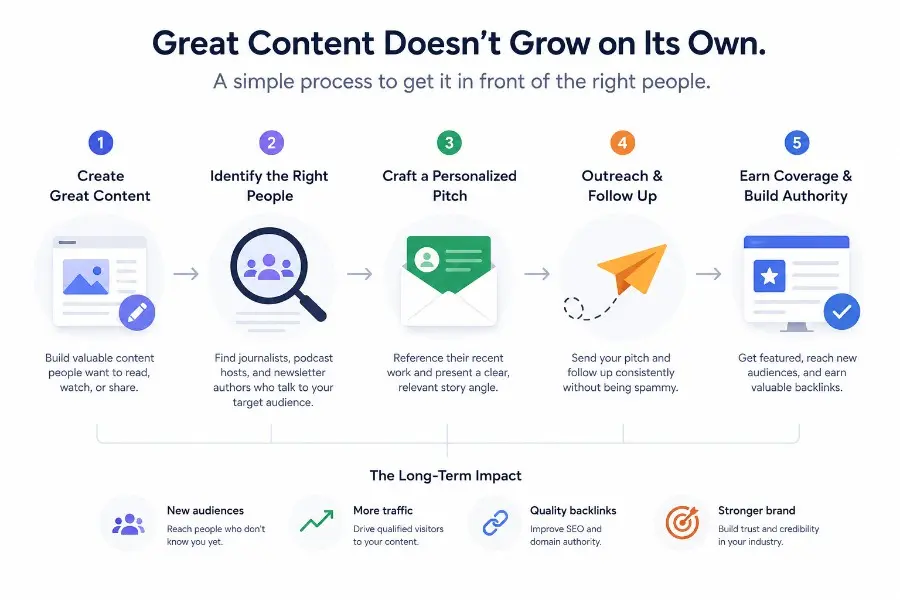
- media mentions generate backlinks,
- backlinks improve domain authority,
- stronger authority improves search rankings,
- improved rankings drive organic discovery,
- additional visibility attracts more press coverage.
The long-term SEO impact of a single well-placed feature can far exceed the initial traffic spike.
The Distribution Problem Most Content Marketers Face
Here is the reality for many marketing teams.
Content gets created, published, shared on social channels, sent to an email list, and then left to compete for attention on its own.
Even teams investing heavily in creative automation and scalable content production often underinvest in distribution systems.
The reason is simple:
Media outreach is operationally difficult to execute consistently.
Proper outreach requires teams to:
- identify relevant journalists and creators,
- understand their recent coverage,
- personalize every pitch,
- frame stories around audience relevance,
- manage follow-ups systematically,
- maintain outreach momentum over time.
Most marketing teams do not have dedicated infrastructure for this.
As a result, outreach becomes inconsistent, manual, and difficult to scale — especially for lean teams already focused on content production, SEO, design systems, localization, and campaign operations.
How Magic Pitch Solves the Distribution Side of Content Marketing
Magic Pitch is designed specifically to solve this distribution problem.
It is a PR, podcast, and newsletter outreach platform that helps marketing teams systematically place their content, research, campaigns, and brand stories in front of journalists, podcast hosts, and newsletter authors most likely to cover them.
The platform provides access to:
- 700,000+ journalists,
- 3.8 million podcasts,
- verified newsletter and Substack contacts.
Teams can search using natural language queries such as:
- “marketing newsletters covering AI automation,”
- “podcasts focused on SaaS growth,”
- “journalists writing about creative automation,”
- “publications covering e-commerce infrastructure.”
This is particularly valuable for companies building modern marketing infrastructure products such as:
- image generation APIs,
- AI marketing tools,
- visual automation platforms,
- SaaS creative workflows,
- embedded design editors,
- marketing automation systems.
What makes Magic Pitch especially useful is that it does not stop at contact discovery.
The platform researches each contact individually and generates personalized outreach based on recent coverage history, podcast topics, editorial focus, and publishing behavior.
Instead of generic templates, outreach becomes context-aware and relevant.
The platform also surfaces:
- predicted response rates,
- ideal send times,
- recommended pitch length,
- tone recommendations,
- follow-up automation.
This transforms media outreach from an inconsistent manual task into a repeatable distribution workflow.
Where Media Outreach Fits in a Modern Content Workflow
The most effective marketing organizations now treat media outreach as the distribution layer on top of scalable content production.
That content may include:
- blog articles,
- automated visual campaigns,
- original research,
- dynamic landing pages,
- AI-generated marketing assets,
- e-commerce campaign visuals,
- lifecycle email creative,
- data-driven reports.
Here is how distribution connects to those workflows in practice.
Campaign Launches
When launching:
- new products,
- API features,
- AI workflows,
- visual automation tools,
- creative infrastructure products,
- marketing platforms,
earned media can significantly amplify visibility.
The supporting content and branded visuals become the evidence base for the pitch.
Modern teams increasingly use automated creative production systems to generate launch visuals at scale across:
- social media,
- ads,
- email campaigns,
- localization variants,
- product announcements,
- press assets.
Platforms like Pixelixe help automate these visual workflows through template-based image generation, branded design systems, and scalable rendering APIs.
Original Research and Data
Original research remains one of the strongest drivers of backlinks and earned media coverage.
Journalists and newsletter authors actively seek:
- proprietary statistics,
- trend reports,
- industry benchmarks,
- survey results,
- market analysis.
For companies working in visual automation, AI-assisted marketing, SaaS infrastructure, or e-commerce tooling, research-backed content often performs exceptionally well as a distribution asset.
The combination of:
- original research,
- automated visual storytelling,
- infographic generation,
- dynamic charts,
- branded social assets
creates highly shareable content ecosystems.
Thought Leadership and Industry Commentary
Opinion pieces and strong perspectives tied to industry trends are ideal for podcast outreach and newsletter features.
This is especially relevant in rapidly evolving categories such as:
- AI-assisted marketing,
- creative automation,
- image generation infrastructure,
- API-first SaaS tooling,
- personalization systems,
- scalable visual production.
The ability to quickly generate branded visual assets around thought leadership topics also improves distribution readiness.
Using template-based design systems and image generation APIs, teams can rapidly create:
- social quote cards,
- branded infographics,
- podcast promotional assets,
- newsletter graphics,
- localized visual variants.
Product News and Milestones
Funding announcements, product launches, customer milestones, platform integrations, and expansion news all create opportunities for earned media.
The difference is that successful companies do not simply publish a press release and hope journalists discover it.
They combine:
- content creation,
- automated visual production,
- campaign distribution,
- targeted media outreach,
- backlink acquisition,
- SEO amplification.
This integrated approach produces significantly better long-term visibility.
What Good Media Pitching Looks Like
The most common outreach mistake is leading with the product itself.
Journalists and newsletter authors are not looking for advertising copy.
They are looking for stories relevant to their audience.
Effective media outreach usually does three things:
- Connects the story to topics the recipient already covers
- Frames the angle clearly and quickly
- Makes responding easy and low-friction
This is where research-backed personalization becomes valuable.
Magic Pitch uses AI-assisted research to build context-aware pitches that reference recent coverage, editorial interests, and relevant industry discussions.
For teams already using AI-assisted creative production and scalable visual generation workflows, this creates a consistent operational pattern:
- automate repetitive production,
- personalize intelligently,
- scale systematically.
Alongside media outreach, building stronger search visibility through backlink acquisition remains important.
Working with agencies specializing in SEO and authority building services like Digital Climbs can help amplify the long-term SEO value generated by earned media coverage.
Why Distribution Infrastructure Matters More Than Ever
Content production is no longer the bottleneck it once was.
Modern marketing teams can now generate:
- branded visuals,
- personalized creatives,
- localized campaigns,
- dynamic banners,
- e-commerce assets,
- lifecycle email graphics,
- AI-assisted promotional content
at unprecedented scale using creative automation platforms and image generation APIs.
The new bottleneck is distribution.
The teams getting the most value from content marketing are not necessarily producing the most content.
They are the teams combining:
- scalable visual production,
- SEO,
- earned media,
- backlinks,
- podcast outreach,
- newsletter placement,
- distribution automation,
- authority building.
Creating great content without a strong distribution strategy limits its impact.
Media outreach expands reach beyond your owned audience and compounds the long-term value of every piece of content you publish.
Platforms like Magic Pitch help make that process operational, scalable, and repeatable for modern marketing teams.
And as content production itself becomes increasingly automated through tools like Pixelixe, the companies that win attention will be the ones pairing scalable creative generation with equally scalable distribution systems.