
In 2026, creative teams face a scaling problem: content demand is growing fast, but manual production workflows are not. Marketing teams now need visuals for ads, email campaigns, e-commerce catalogs, marketplaces, social media, localization, personalization, and lifecycle automation at a pace traditional design tools were never built to support.
Direct Answer
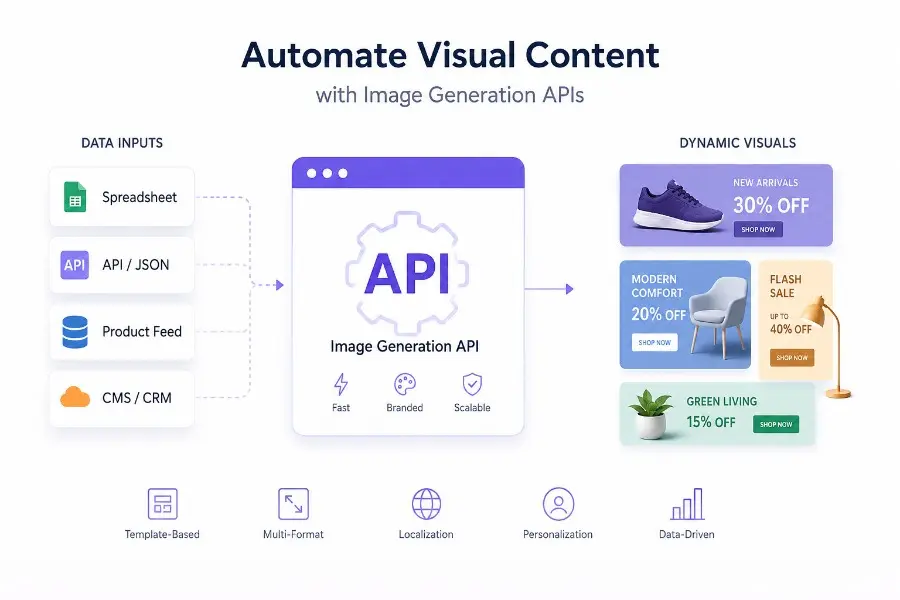
An image generation API turns structured data, templates, and brand rules into finished graphics programmatically. For marketing teams, the highest-value workflow is not text-to-image experimentation, but repeatable production: one approved layout, many on-brand variants, and automated rendering from a product feed, spreadsheet, CMS, CRM, or backend service.
Image generation API workflows that still earn clicks in AI Search
| Workflow | Search intent | Why it is resistant to AI Overviews |
|---|---|---|
| Dynamic campaign banners | how to generate many ad variants from data | Users need implementation details, template logic, and an API vendor |
| Product catalog visuals | automated ecommerce product images | The query usually leads to a build-or-buy decision |
| Open Graph and social cards | dynamic OG image generator | Developers need code, rendering constraints, and examples |
| AI-agent layout creation | JSON to graphic API | The answer depends on editable asset workflows, not a generic definition |
Why Pixelixe fits this workflow
Pixelixe is strongest when a team needs editable branded templates plus API rendering. Studio creates the first layout, Brand Kit keeps reusable visual rules consistent, and the Image Generation API renders production variants from structured data.
Author and update note
Updated on May 20, 2026 by the Pixelixe team to reflect Google AI Search, AI Overviews, AI Mode, and practical visual automation workflows. Pixelixe builds tools for branded image automation, template-based creative production, embedded editing, and API-driven visual generation.
FAQ
What is the difference between an image generation API and a text-to-image model?
A text-to-image model creates a new visual from a prompt. An image generation API usually renders predictable branded outputs from templates, JSON, CSV rows, product feeds, or personalization data.
When should a team use Pixelixe for visual automation?
Use Pixelixe when the workflow requires brand consistency, editable templates, approval before scaling, and automated rendering across ads, ecommerce, social media, email, or Open Graph images.
This is where image generation APIs and creative automation platforms have become essential infrastructure. Instead of manually recreating every banner, social post, product image, or campaign variation, teams can build scalable visual systems powered by templates, APIs, spreadsheets, product feeds, and AI-assisted workflows.
Modern platforms like Pixelixe help brands move from manual graphic production to programmable visual generation: reusable templates, structured data, automated rendering, and brand-consistent visuals at scale.
Scalable Design Systems Powered by APIs
Traditional design workflows rely heavily on repetitive manual production:
- resizing creatives for different channels,
- exporting multiple banner formats,
- updating promotional visuals,
- localizing campaign assets,
- recreating product graphics for every audience or market.
At scale, these tasks consume creative bandwidth while adding little strategic value.
Template-based image generation changes this model completely. Designers create reusable branded templates with dynamic placeholders, then connect those templates to structured data sources such as spreadsheets, CRMs, CMS platforms, product catalogs, REST APIs, GraphQL endpoints, or live feeds.
The workflow becomes simple:
- Design the template once
- Connect dynamic data sources
- Generate branded visuals automatically
This JSON-to-image approach enables teams to create thousands of consistent visuals programmatically while keeping full control over layout, typography, brand colors, and messaging.
For production workflows, the Pixelixe Image Generation API can render branded images from approved templates and structured data, making it useful for campaign visuals, e-commerce images, lifecycle marketing assets, and multi-format creative production.
From JSON to Dynamic Visual Production
At the core of scalable visual automation lies structured data.
A JSON payload can define:
- headlines,
- product images,
- prices,
- CTAs,
- colors,
- localization variables,
- campaign metadata,
- personalization rules,
- layout variables.
The rendering engine then transforms that data into finished visuals automatically.
This enables workflows such as:
- dynamic banner generation,
- personalized ad creatives,
- automated social media images,
- marketplace listing graphics,
- email campaign visuals,
- localized campaign variants,
- e-commerce catalog image automation,
- AI-assisted marketing creative production.
For example, an online retailer can generate thousands of promotional product visuals directly from a product feed. When a price, discount, stock status, or seasonal campaign changes, the visuals can be regenerated automatically without asking a designer to manually update every asset.
This is where spreadsheet-driven and feed-driven image generation become especially valuable. Marketing teams can connect structured data to approved templates and produce fresh, brand-compliant visuals at scale.
Creative Automation Across Channels
Generating the visual is only one part of the workflow. Modern creative automation also helps teams prepare assets for distribution across multiple channels.
Marketing teams often need creative variations for:
- social media,
- display advertising,
- email marketing,
- marketplaces,
- landing pages,
- affiliate campaigns,
- mobile apps,
- CRM and lifecycle automation.
Automation can handle production tasks such as resizing, format adaptation, compression, export variations, and image processing. Instead of manually adapting every creative for every channel, teams can orchestrate visual production through APIs and automated rendering pipelines.
The Pixelixe API platform is designed for developers and product teams that need creative automation, template rendering, embedded editing, brand rules, and image processing in one workflow.
E-Commerce Image Automation at Scale
E-commerce is one of the strongest use cases for image generation APIs.
Online stores constantly update:
- prices,
- discounts,
- product images,
- inventory status,
- promotional badges,
- seasonal campaigns,
- localized currencies and languages.
Manually updating visuals for a large catalog quickly becomes unsustainable.
Image generation APIs solve this by connecting product data directly to branded templates. A single automation pipeline can generate product cards, discount banners, marketplace visuals, social commerce creatives, retargeting ads, and localized campaign assets.
This keeps visuals accurate, current, and conversion-ready while reducing the production burden on design and marketing teams.
For recurring workflows, Pixelixe Automated Image Generation supports repeatable visual production from reusable layouts, spreadsheets, APIs, and structured inputs. When visual automation depends on live product, pricing, inventory, or fulfillment data, the broader eCommerce API architecture matters just as much as the image-rendering layer.
JSON-to-Graphic and AI-Assisted Creative Workflows
Not every workflow starts from an approved template. Sometimes, a team or AI agent needs to create the first editable layout from structured intent, a campaign brief, or a JSON payload.
That is where JSON-to-graphic workflows become useful.
A JSON-to-graphic system can turn structured instructions into an editable branded asset. Once the layout is reviewed and approved, the same design can become a reusable template for large-scale image generation.
This creates a practical workflow:
- Generate or assemble the first branded layout
- Review and refine it visually
- Save it as an approved template
- Render thousands of production variations through an API
For teams experimenting with AI-assisted creative production, the Pixelixe JSON to Graphic API supports workflows where structured inputs, AI agents, or backend systems need to generate editable layouts before production rendering begins.
Image Editing and Processing APIs
Creative automation is not only about generating new visuals. Many workflows also require image editing and processing before or after rendering.
Common image processing needs include:
- resizing,
- cropping,
- compression,
- format conversion,
- overlays,
- filters,
- background preparation,
- image optimization for web or ads.
Instead of building and maintaining an internal image processing stack, teams can use APIs to automate these transformations.
The Pixelixe Image Editing API supports image transformations such as resize, crop, rotate, flip, compress, convert, blur, and overlay operations through API calls.
Measuring Creative Performance Programmatically
One of the biggest advantages of automated creative production is measurability.
Because visuals are generated programmatically, teams can attach tracking parameters and metadata to every generated asset. This makes it easier to analyze performance across:
- headlines,
- layouts,
- colors,
- product images,
- CTAs,
- audience segments,
- localization variants,
- campaign formats.
Instead of relying only on slow manual A/B testing cycles, marketers can run many small creative experiments continuously.
This transforms visual production from a static design process into a data-driven optimization system.
Security and Reliability in Automated Visual Pipelines
When visual automation connects to live business data, security becomes critical.
Creative pipelines may process:
- customer data,
- campaign assets,
- product catalogs,
- pricing information,
- confidential marketing content,
- internal brand resources.
Reliable systems should include secure API authentication, access controls, rate limiting, signed asset URLs, encrypted storage, and auditability.
For larger data collection or regional workflow requirements, some teams also use networking infrastructure such as a socks5 proxy to help manage traffic routing, regional access, and data acquisition workflows at scale.
The Human Role in Creative Automation
Creative automation does not replace creative direction.
Designers still define:
- brand identity,
- template systems,
- visual hierarchy,
- campaign concepts,
- messaging structure,
- creative quality standards.
Automation handles scale, consistency, and repetitive execution. Humans remain responsible for taste, storytelling, strategy, and judgment.
The best creative automation systems give designers more leverage. Instead of spending hours resizing assets or updating repetitive campaign variations, creative teams can focus on ideas, performance, brand consistency, and experimentation.
Why Creative Automation Is Becoming Essential
The demand for visual content will continue growing across every digital channel.
Brands now need:
- personalized ads,
- localized campaigns,
- dynamic banners,
- automated email visuals,
- marketplace graphics,
- e-commerce product images,
- lifecycle marketing creatives,
- AI-assisted campaign assets,
- scalable social media variations.
Manual production cannot keep up with this level of demand efficiently.
Image generation APIs, template-based visual systems, JSON-to-image workflows, and image processing APIs are becoming foundational infrastructure for modern marketing operations.
Businesses that adopt scalable visual automation gain advantages in:
- production speed,
- campaign agility,
- personalization,
- localization,
- creative consistency,
- operational efficiency,
- experimentation at scale.
The future of creative production is increasingly API-driven, data-connected, and automation-powered — with platforms like Pixelixe helping teams build scalable branded visual workflows for ads, email, social media, e-commerce, SaaS platforms, marketplaces, and lifecycle campaigns.