
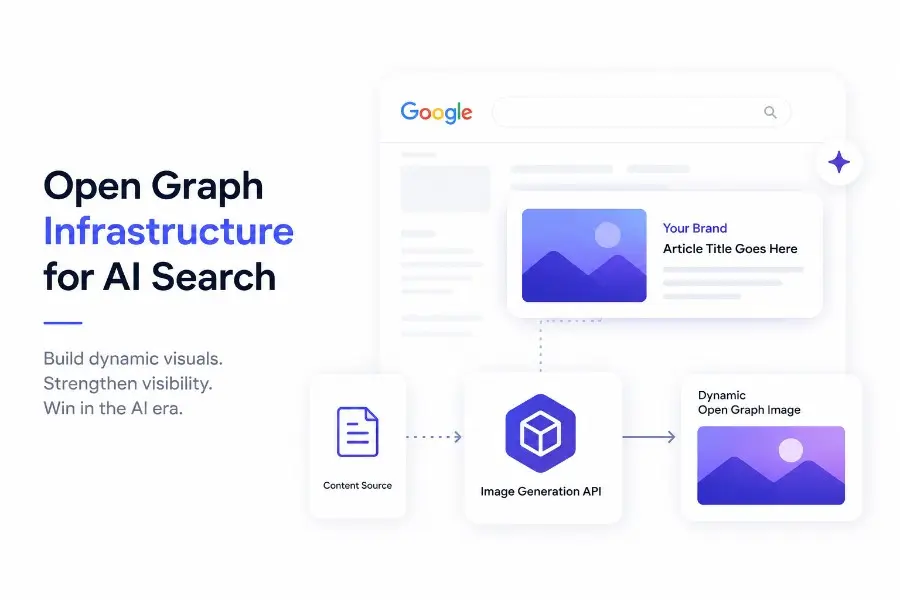
Quick Answer: Open Graph images are evolving from simple social sharing assets into core components of AI-driven search infrastructure.
As Google Search shifts toward:
- AI Overviews,
- conversational search,
- multimodal retrieval,
- generated previews,
- AI-assisted discovery,
visual infrastructure increasingly influences:
- branded discoverability,
- click-through rates,
- entity recognition,
- semantic consistency,
- AI-generated previews,
- visual trust signals.
The companies that build scalable visual systems around dynamic image generation, reusable templates, rendering APIs, and automated visual workflows will likely gain long-term advantages in AI-first search environments.
This is no longer just about “social media graphics.”
It is becoming part of how search systems interpret, present, and trust brands online.
The Search Layer Is Becoming Increasingly Visual
Traditional SEO was primarily text-centric.
The old model focused on:
- keywords,
- backlinks,
- metadata,
- text relevance,
- crawlability.
That model is changing rapidly.
Modern AI-driven search systems increasingly combine:
- text understanding,
- semantic extraction,
- visual interpretation,
- entity recognition,
- multimodal retrieval.
This changes the role visuals play in discoverability.
Search engines no longer simply index pages.
They increasingly generate:
- summaries,
- previews,
- recommendation cards,
- AI-generated answers,
- contextual snippets.
And those interfaces are becoming increasingly visual.
This is why Open Graph infrastructure matters far more than most websites currently realize.
Open Graph Images Are No Longer Just Social Assets
Many marketers still think Open Graph images only affect Facebook previews or social sharing.
That assumption is outdated.
Modern Open Graph systems increasingly influence:
- AI-generated snippets,
- preview systems,
- messaging platforms,
- conversational search interfaces,
- branded recommendation systems,
- content summarization layers.
As explained in Pixelixe’s article about brand visibility across AI-first discovery systems, future discoverability depends heavily on how consistently brands appear across search, social, and AI-generated environments.
Visual consistency increasingly contributes to:
- entity reinforcement,
- trust perception,
- branded memorability,
- semantic recognition,
- CTR optimization.
This becomes especially important for:
- publishers,
- SaaS companies,
- ecommerce brands,
- marketplaces,
- media websites,
- AI-generated content systems.
For publishers monetizing traffic through advertising and best ad networks for publishers, visual optimization increasingly affects engagement and monetization performance directly.
Why Static Visual Systems Break in AI-Driven Search
The traditional workflow for Open Graph images was simple:
- Design image manually
- Export asset
- Upload image
- Add meta tags
That model breaks completely at scale.
Modern websites now generate:
- thousands of pages,
- localized campaigns,
- dynamic landing pages,
- AI-generated content,
- ecommerce collections,
- programmatic SEO pages.
Manual image workflows become operational bottlenecks.
Static systems create major limitations:
- inconsistent branding,
- slow publishing velocity,
- localization friction,
- poor scalability,
- personalization limitations,
- operational inefficiencies.
As AI-generated search systems continue scaling, publishing velocity itself becomes a competitive advantage.
This is why dynamic visual infrastructure matters.
The Rise of Dynamic Visual Infrastructure
Dynamic Open Graph systems automate image generation programmatically.
Instead of manually creating visuals one by one, organizations build reusable rendering systems powered by:
- templates,
- APIs,
- rendering engines,
- dynamic variables,
- automation workflows.
A modern workflow typically looks like this:
- Content gets published
- Variables populate a visual template
- Rendering infrastructure generates the image automatically
- CDN systems cache and distribute the asset globally
- Crawlers retrieve optimized visuals dynamically
This allows organizations to maintain:
- visual consistency,
- publishing speed,
- scalable content operations,
- automated personalization.
Pixelixe explored this evolution deeply in its guide to programmatic Open Graph image generation in 2026.
Visual Consistency Is Becoming an Entity Signal
One of the least discussed aspects of AI Search is how systems increasingly interpret recurring visual structures.
Repeated use of:
- typography,
- layouts,
- brand colors,
- visual hierarchy,
- design systems,
- image structures,
helps reinforce recognizable entity patterns.
This matters because AI systems increasingly attempt to determine:
- trust,
- authority,
- consistency,
- source reliability.
In many industries, visual consistency is becoming part of semantic consistency.
The websites most likely to dominate AI-driven discovery are not necessarily the ones producing the most content.
They are often the ones producing:
- the most recognizable systems,
- the most structured assets,
- the most reusable infrastructure,
- the most consistent semantic signals.
Why Visual Infrastructure Is Becoming Part of GEO
GEO (Generative Engine Optimization) is fundamentally different from traditional SEO.
Traditional SEO focused heavily on:
- rankings,
- keywords,
- links.
GEO increasingly focuses on:
- extractability,
- entity trust,
- semantic clarity,
- multimodal consistency,
- source authority.
Visual systems now contribute directly to those signals.
Well-structured Open Graph infrastructure helps improve:
- AI-generated previews,
- visual memorability,
- branded differentiation,
- multimodal retrieval quality,
- semantic consistency.
As AI-generated interfaces become more common, websites with stronger visual systems will likely gain disproportionate visibility advantages. Investing in this infrastructure early is one of the clearest ways to improve AI search visibility before these systems become the norm.
The Technical Stack Behind AI-Ready Visual Systems
Modern Open Graph infrastructure usually relies on four core layers.
1. Template Infrastructure
Templates define:
- layouts,
- typography,
- visual hierarchy,
- placeholders,
- logos,
- reusable structures.
Reusable templates are critical for scalable automation.
This is one reason Pixelixe emphasizes structured visual systems rather than isolated editing workflows in its article about why brands need more than an image editor.
2. Dynamic Data Systems
Modern rendering systems automatically inject:
- titles,
- prices,
- metadata,
- localized text,
- product information,
- user-generated content,
- campaign variables.
This allows organizations to generate thousands of unique visuals automatically.
3. Rendering Infrastructure
Rendering systems increasingly rely on:
- HTML/CSS rendering,
- SVG rendering,
- headless browsers,
- rendering APIs,
- server-side image generation.
Performance becomes critically important at scale.
Rendering latency affects:
- crawler accessibility,
- publishing speed,
- cache efficiency,
- operational scalability.
4. Delivery Infrastructure
After generation, assets should be:
- optimized,
- cached,
- globally distributed,
- CDN accelerated.
This ensures reliable retrieval by:
- social crawlers,
- AI systems,
- messaging apps,
- search engines.
Poor infrastructure negatively impacts:
- preview generation,
- social performance,
- AI retrieval quality.
Real-World Infrastructure Workflows
SaaS Publishing Systems
A SaaS company publishing dozens of articles weekly can automate:
- blog visuals,
- Open Graph previews,
- branded snippets,
- social assets.
Workflow:
- CMS publishes article
- Rendering API generates image
- Variables populate templates
- CDN distributes optimized assets globally
This creates:
- faster publishing,
- visual consistency,
- scalable content operations.
Ecommerce Visualization Systems
Modern ecommerce brands increasingly generate:
- pricing banners,
- localized campaigns,
- promotional visuals,
- category graphics,
- marketplace assets,
automatically.
Pixelixe explored how ecommerce visualization itself is evolving toward AI-first systems in its article about AI-first ecommerce visualization.
Automated Social Media Systems
Many brands now automate social image generation directly from APIs.
Pixelixe explained this workflow in detail in its guide about auto-generating social media content with image generation APIs.
Pixelixe also explored broader automation strategy in its article about how automation benefits social media marketers.
The Biggest Mistake Most SEO Teams Still Make
Most SEO teams still think content production is primarily about:
- text,
- keywords,
- publishing frequency.
That model is becoming increasingly incomplete.
AI-driven search systems increasingly evaluate:
- semantic consistency,
- multimodal structures,
- recognizable entities,
- reusable content systems,
- visual trust signals.
The future winners will likely be organizations building:
- scalable content infrastructure,
- reusable visual systems,
- automated rendering pipelines,
- structured semantic ecosystems.
Not simply publishing more articles.
Why This Matters for Pixelixe
Pixelixe operates directly at the intersection of:
- dynamic image generation,
- visual automation,
- scalable rendering,
- AI-ready publishing infrastructure,
- programmatic visual systems.
As AI-driven discovery evolves, these systems become increasingly important for:
- SEO,
- GEO,
- AI visibility,
- social distribution,
- branded discoverability.
This is no longer just a design problem.
It is increasingly a discoverability infrastructure problem.
FAQ
Why are Open Graph images becoming more important in AI Search?
AI systems increasingly rely on multimodal understanding that combines text, metadata, and visual signals when generating previews and recommendations.
What is dynamic Open Graph image generation?
Dynamic Open Graph generation automatically creates visuals using templates, APIs, and dynamic variables instead of manually designing assets individually.
Why does visual consistency matter for SEO?
Consistent visual systems help reinforce recognizable entity patterns, branded trust signals, and semantic consistency across platforms.
What is GEO?
GEO (Generative Engine Optimization) focuses on optimizing content and infrastructure for AI-generated search environments rather than traditional ranking systems alone.
Why do scalable visual systems matter?
As websites scale content production, manual visual workflows become bottlenecks. Automated visual infrastructure improves scalability, consistency, and publishing velocity.
Final Thoughts
The future of search is becoming increasingly multimodal.
As AI systems continue transforming how users discover information, visual infrastructure will likely become far more important than most SEO teams currently expect.
Open Graph systems are evolving from simple social metadata into strategic discoverability infrastructure.
The organizations investing early in:
- scalable visual systems,
- reusable rendering infrastructure,
- dynamic image generation,
- automated visual workflows,
- semantic visual consistency,
will likely gain significant long-term advantages in AI-first search ecosystems.
In the future of AI Search, visual infrastructure is no longer optional.
It is becoming part of search infrastructure itself.