Use case
Brand-safe marketing visuals
Generate recurring campaign assets from approved templates while keeping fonts, colors, logos, and layouts controlled.
Use this comparison when your team is choosing between document-style template generation and branded visual automation. Pixelixe is strongest when the core job is editable, brand-controlled image production across ads, ecommerce, social cards, email headers, and embedded workflows.
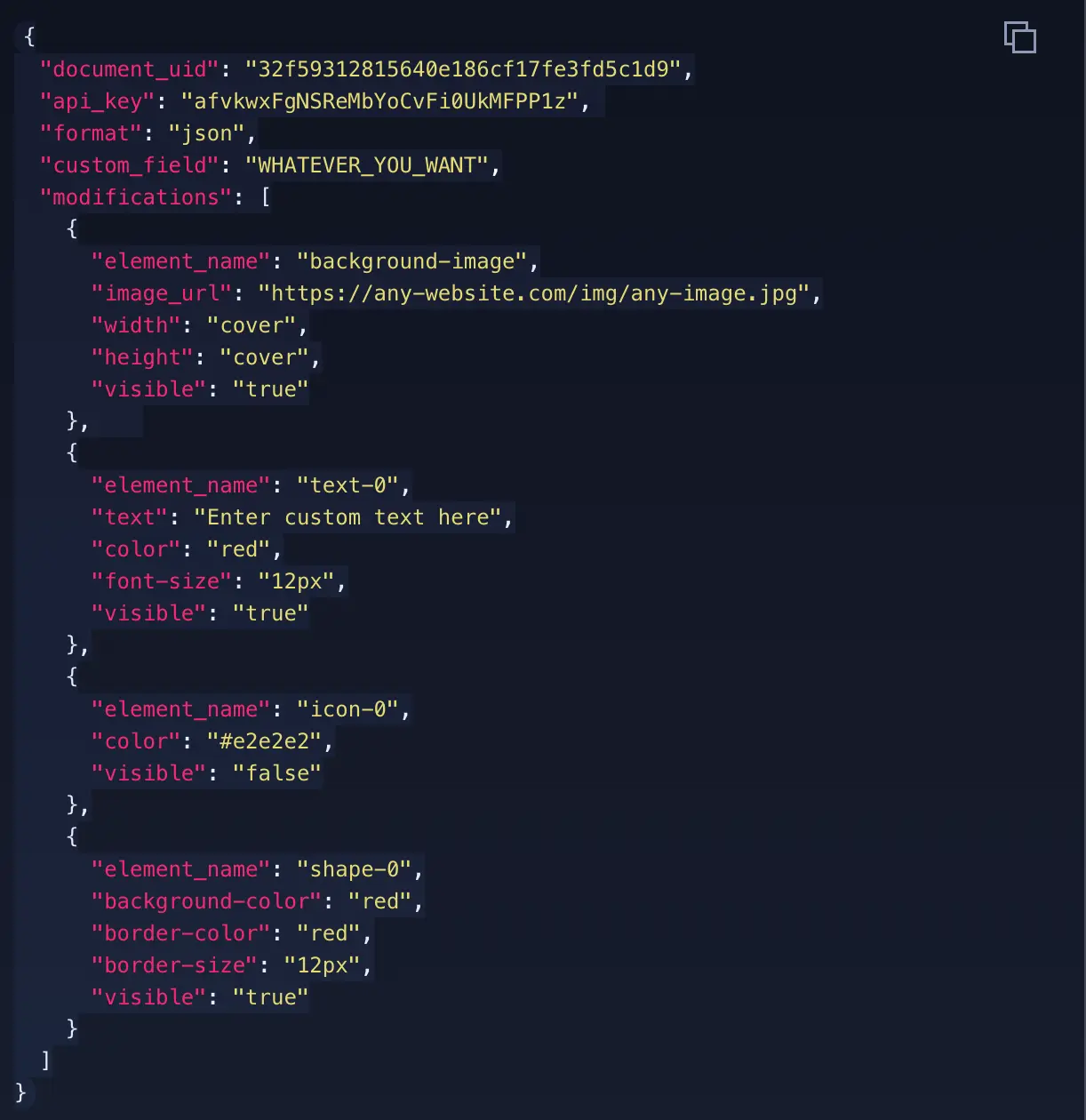
Structured JSON, editable templates, and branded rendering from one Pixelixe workflow.
The right tool depends less on the word API and more on the production system around the template.
| Criterion | Pixelixe | APITemplate.io |
|---|---|---|
| Primary job | Branded image, banner, social card, email, ecommerce, and embedded visual production. | Automated document, PDF, and image generation from templates. |
| Visual template workflow | Studio-created templates, Brand Kit control, spreadsheet runs, API rendering, and white-label editing. | Template creation for document and image generation workflows. |
| Editable output path | Strong fit when teams need reviewable templates and editable workflows before final rendering. | Good fit when the output is primarily generated from a prebuilt document or image template. |
| SaaS embedding | Designed for teams that may need a white-label editor inside their own product. | Evaluate separately if embedded end-user editing is a core product requirement. |
| Best first test | Can one approved visual system support ads, ecommerce visuals, OG images, email headers, and API outputs? | Can one template reliably produce the PDF or document outputs your operations workflow needs? |
These are the scenarios where the buying intent is closer to visual automation than to document automation.
Generate recurring campaign assets from approved templates while keeping fonts, colors, logos, and layouts controlled.
Turn catalog data, product shots, prices, offers, and localized copy into reusable branded image variants.
Let users or internal teams edit approved visual templates inside your own product experience.
Use structured JSON, Brand Kit rules, and editable layouts when AI systems need to generate reviewable graphics.
APITemplate.io is commonly evaluated for automated images and PDFs. Pixelixe should be evaluated when the team needs a design system that can move from editable template creation to recurring branded image generation, with marketers, developers, and product teams sharing one workflow.
Use Pixelixe when visual brand control, reusable templates, and editable outputs are central to the workflow.
Use APITemplate.io first when the workflow is mainly PDF or document assembly.
Run the decision test with one real campaign asset, one real document, and one real data payload.
Use a practical test instead of comparing generic feature lists.
Create one representative visual template and one representative document template.
Send the same real fields: title, image URL, price, CTA, brand color, and locale.
Check who can edit, approve, and reuse the generated output before publishing.
Compare cost, output formats, team ownership, API ergonomics, and long-term maintenance.
Use these connected pages to validate the buying path, implementation path, and Pixelixe workflow fit.
This page uses public product positioning and practical implementation criteria. Validate final vendor fit against current official documentation before procurement.
Yes, when the workflow is primarily branded image automation, template rendering, white-label editing, or AI-ready visual production.
Keep APITemplate.io on the shortlist when PDF and document generation are the core production requirement.
Test one real visual asset family and one real data source. The winner is the tool that keeps the production workflow easiest to own after the first template is live.
The best review is not a generic demo. Use one real template, one real data source, and one real publishing path to decide whether Pixelixe should own this visual automation workflow.