
What is the best Profound alternative in 2026?
For a brand team correcting how AI answers describe the company, the best Profound alternative is SE Visible by SE Ranking: a wrong description opens into the unedited answer and the pages behind it, each with its search data. Semrush AI Visibility Toolkit is best for weekly tone and attribute reads, Peec AI for the arguments AI makes against your brand, Ahrefs Brand Radar for a category mention baseline with no setup, and Otterly.AI for brand profiles and sentiment across unlimited countries. Profound still leads on one thing: its Enterprise sentiment view ranks recurring AI narratives, with source URLs and a perception-versus-reality split. Below, the eight Profound alternatives answer three brand-desk questions.
Half of B2B software buyers (51%) now start research with an AI chatbot more often than with Google, up from 29% a year earlier, across 1,076 buyers surveyed. An engine now writes the first description a buyer reads, quoting pages you may never have reviewed, and brand perception starts forming there before your own site loads. Read that answer as published copy about your company, because your buyers already do.
Profound alternatives compared on wording, sentiment, and sources
The table compares eight Profound alternatives, and Profound itself, on four brand-desk checks: whether you can open the exact answer, how sentiment is broken down, how far a description traces to its source, and the entry price as each vendor shows it.
| Platform | Exact answer text | Sentiment view | Source trace | Entry price |
|---|---|---|---|---|
| Profound (baseline) | Not stated | Enterprise narrative themes | URLs per narrative | Free 7-day trial; Enterprise custom |
| SE Visible | Every answer, unedited | Net sentiment by topic | Cited URLs with SEO data | Plans on visible.seranking.com |
| Semrush AI Visibility Toolkit | Not stated | Weekly tone, attributes | Not stated | $99 per month |
| Similarweb AI Brand Visibility | What AI responded | Sentiment by topic | Exact link | $99/mo billed annually |
| Peec AI | Not stated | Sentiment, attribute scoring | URL-level sources | $95/mo |
| Bluefish | Not stated | Versus competitors | Down to URL | Demo only |
| Ahrefs Brand Radar | Every response stored | Brand sentiment tracked | Citation counts | From $50/mo |
| Evertune | Not stated | AI Brand Score | Not stated | $60/mo Starter |
| Otterly.AI | Not stated | Brand Sentiment Analytics | Source classification | $29/mo |
Can you read the exact words an AI answer used about your brand?
A visibility score says how often your brand appears. Only the stored answer says what the engine claimed: your category, the adjectives, the rivals named beside you, and the errors. You need the response, dated and tied to an engine and market, before calling a description wrong.
How the machine describes us: that comes before any chart.
The unedited answer kept behind every visibility number.
Sentiment split by topic, not one blended score.
Each description traced to its source page, so the fix has an owner.
I scored all eight on these, using each vendor’s own product and pricing pages.
Can you trace a wrong description back to the page behind it?
Yes, when the platform stores the cited pages with each answer it collects. A wrong description then becomes a page with an owner: the team that edits it makes the correction, and the next round of answers shows whether it held.
In an SE Visible study of 1,000 US brand keywords, 61% of Google AI Overview citations came from platforms brands manage or take part in. It counted citations, not accuracy. Still, it changes the routing: the cause tends to be a page you can reach, so content or web owns the fix more often than PR. Log owner, cause, fix, and recheck date.
How do you measure brand perception across engines and markets?
Measure brand perception per engine and per market from repeated answers to a fixed prompt set. Read sentiment by topic, such as reliability or category fit, not as one blended score. Then log each misconception with an owner and a recheck date.
A single company-wide reading hides where the description breaks. In an EBU and BBC study across 18 countries and 14 languages, 45% of AI assistant answers about news had at least one significant issue. The study covered news, not brands, but if news gets misread that often, check your own description market by market.
The 8 best Profound alternatives in 2026
SE Visible ranks first for brand teams that correct AI descriptions at the source. The other seven Profound alternatives are ranked by how close each gets you from a score to the sentence an engine wrote and its source page.
1. SE Visible: best Profound alternative
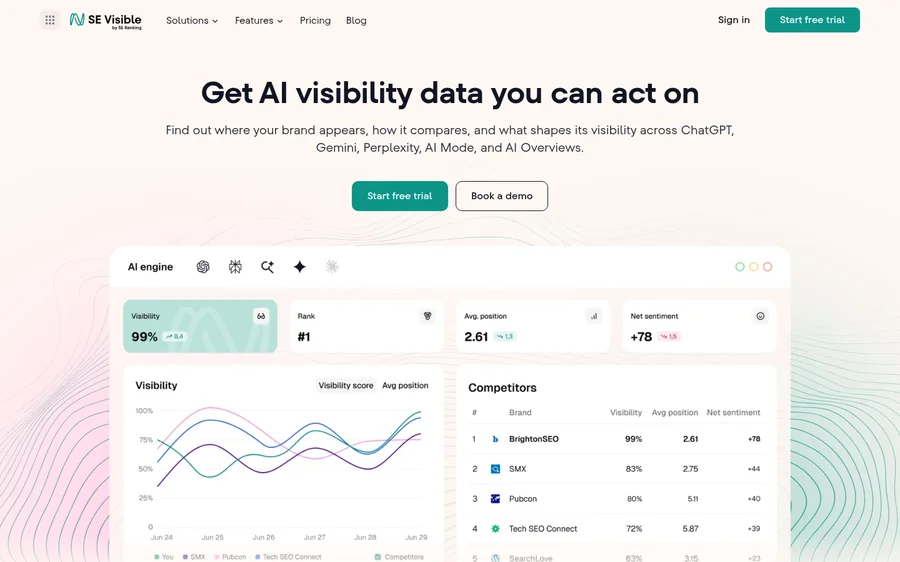
Pasting each engine’s description of your company into a monthly brand doc keeps the wording and loses the page that keeps feeding it. SE Visible by SE Ranking keeps both: this AI visibility platform stores every answer unedited, collected through real browser sessions. Each project tracks a country, or a specific city or region, on Gemini, ChatGPT, Google AI Overviews, and Google AI Mode, daily unless you change the frequency.
Open a wrong description; the citation analysis beneath it gives each cited URL’s traffic, Domain Trust, and whether it links to you.
Best for: heads of brand who answer for the company’s description across markets and assign each fix.
Standout: Brand sentiment analysis ends with an owner. Net sentiment, filtered by topic and engine, finds the description that turned; the “Is my brand mentioned?” filter and Gap score list pages citing rivals, not you. Agents (Beta) file each gap for PR (“Earn third-party mention for AI gap”) or content (“Create content to close AI gap”).
Pros:
- Keeps each dated answer behind every metric
- Weighs cited domains by traffic, Domain Trust, and backlinks
- Feeds Looker Studio; API access on all plans
Cons:
- No multi-country roll-up inside one project
- AI visibility only: the SEO work lives in SE Ranking
- Claude and Copilot support is still planned
Pricing: Plans sit on visible.seranking.com, with a free trial.
At the source: Fix the cited page with the most traffic and Domain Trust first: web owns your pages, PR owns a publication. SE Visible comes from the SE Ranking team, in search for over a decade: a defensible order, not a promise.
2. Semrush AI Visibility Toolkit
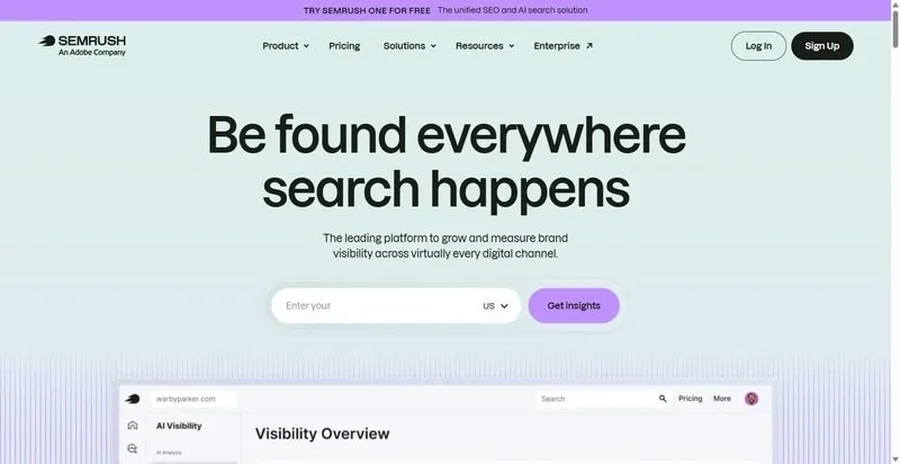
Semrush’s toolkit puts one brand question on a weekly schedule: does AI describe you accurately, and in what tone?
Best for: brand teams wanting weekly tone reads without prompt writing.
Standout: Brand Performance assesses the tone and attributes in AI responses on ChatGPT, Google AI Mode, Gemini, and Perplexity, against rivals. It runs weekly on prompts Semrush generates, not your list. Prompt Tracking runs 25 of your prompts daily.
Pros:
- Flags whether answers describe the brand accurately
- Generates positioning recommendations
- Sends white-label reports to leadership
Cons:
- Weekly reads on synthetic prompts, not your wording
- $99 per extra domain or location, plus $99 per user license
Pricing: $99 per month; 50 more prompts cost $60 monthly.
At the source: It’s a weekly early warning on tone. When an attribute looks wrong, rerun it on your own prompts and find the page behind it first.
3. Similarweb AI Brand Visibility
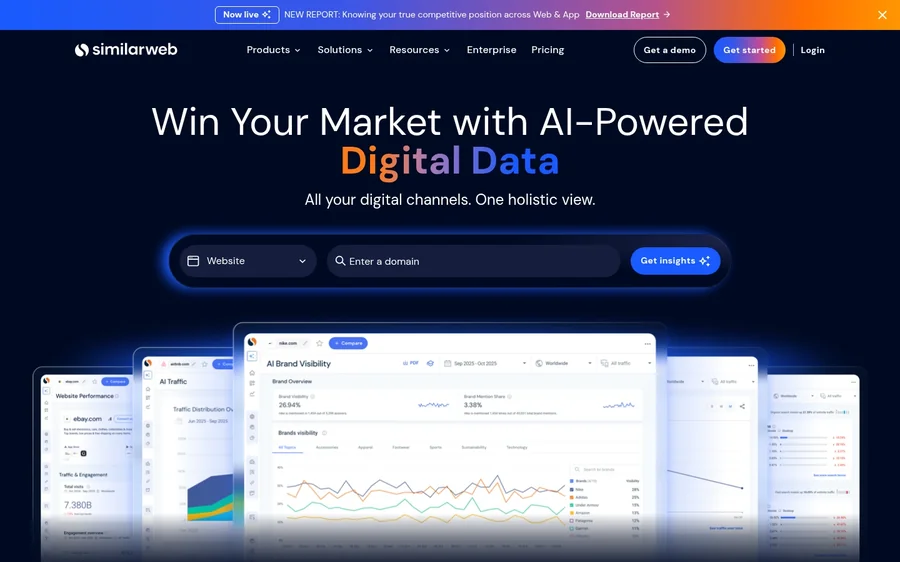
Similarweb’s AI Brand Visibility breaks sentiment down by topic, so a negative reading arrives attached to its subject.
Best for: brand leads comparing sentiment with named competitors, topic by topic.
Standout: The Sentiment Analysis tab sorts how AI answers describe you into positive, negative, and neutral, by topic, against competitors. Prompt Analysis shows what AI responded and its sources, and Citation Analysis goes down to the exact link. ChatGPT, Google AI Mode, Gemini, and Perplexity update daily.
Pros:
- Compares sentiment with competitors per topic
- Traces citations to the exact link
- Lists the top 30 brands per topic
Cons:
- One user on every listed plan
- Only 3 to 6 months of history
Pricing: $99/mo billed annually, or $129/mo; 150 prompts.
At the source: It shows the subject a negative description concerns and the link carrying it. Set recheck dates inside the history window.
4. Peec AI
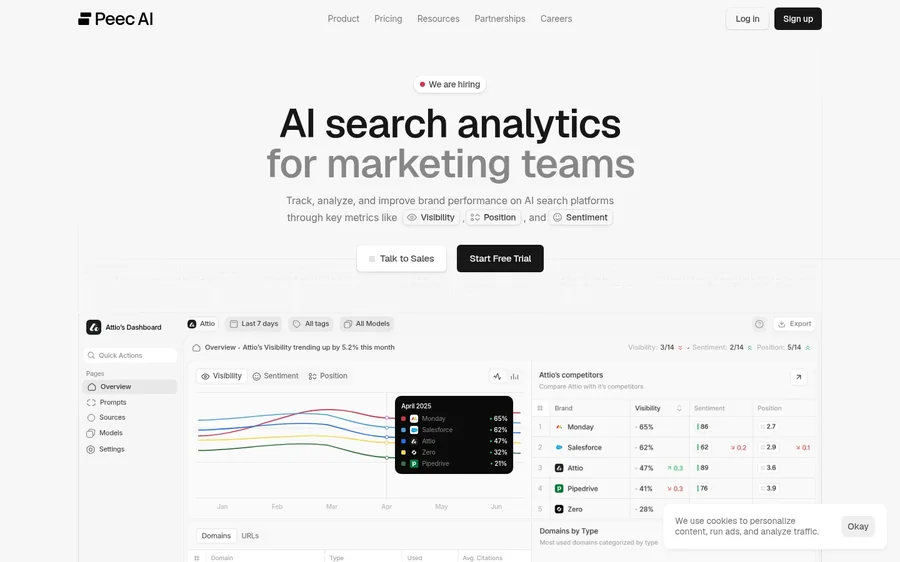
Peec AI scores the gap between what AI says your brand is known for and where you place.
Best for: brand directors holding AI answers against approved brand facts.
Standout: Objections clusters the repeated arguments AI makes against you by meaning and ties each cluster to its source pages: monthly on Pro, weekly on Advanced. That’s a misconception log with sources filled in. Fact-checked prompts test answers against facts you set.
Pros:
- Scores brand attributes on every plan
- Fact-checks 5, 10, or 25 prompts by plan
- Gives unlimited users to content and PR
Cons:
- Three active models per self-serve plan
- No Objections on Starter, which covers one country
Pricing: starter $95/mo, Pro $245/mo, Advanced $495/mo.
At the source: Peec AI vs Profound: Peec AI publishes priced self-serve plans; Profound sells post-trial tracking as custom Enterprise. Start on Pro if objections drive your fixes.
5. Bluefish
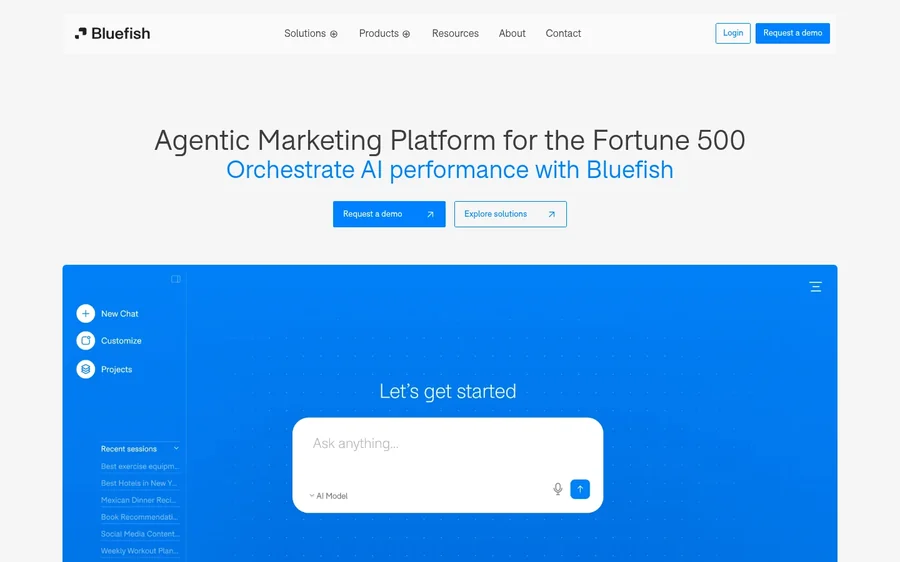
Bluefish routes AI brand work to named teams, from Brand to PR, and sells that model to the Fortune 500.
Best for: enterprise brand offices that want a vendor running the accuracy program with them.
Standout: Every AI claim about you is checked against brand facts you have verified, and each inaccurate one is traced to its source. Corrections take two routes: update the first- or third-party page, or syndicate brand-verified data straight to AI platforms.
Pros:
- Traces each citation down to the URL
- Quantifies sentiment against competitors
- Tracks 10+ LLMs daily, ChatGPT and Gemini included
Cons:
- Publishes no plans or prices; access starts with a demo
- Scoped for Fortune 500 complexity, heavy for a mid-market team
Pricing: Custom and demo-led.
At the source: Choose Bluefish when a wrong claim needs a documented chain from fact to source to owner. Its Full Service option adds custom audits and execution.
6. Ahrefs Brand Radar
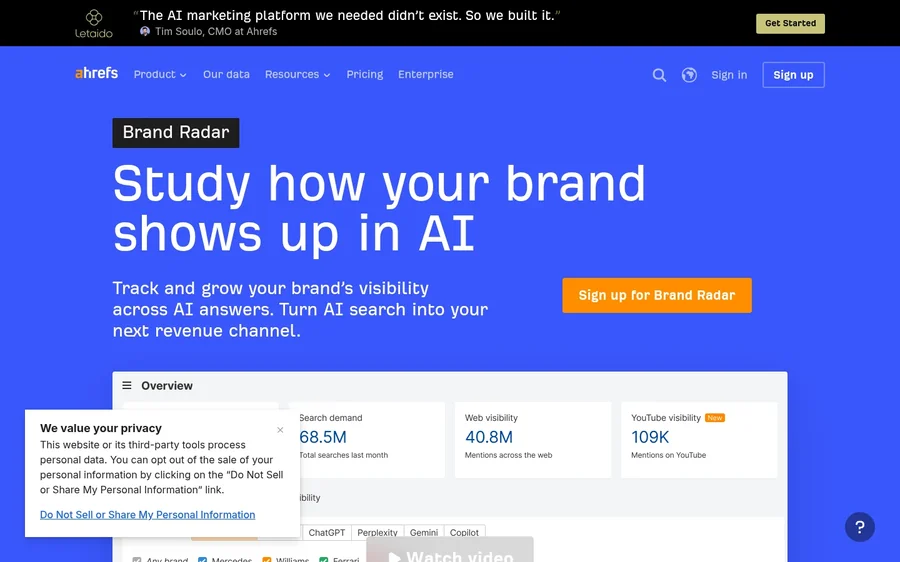
Ahrefs Brand Radar stores every AI response it collects, so a mention count opens into the answers behind it.
Best for: a cross-engine mention baseline for the brand-health read.
Standout: The AI Visibility Index runs over 500 million prompts across ChatGPT, Gemini, Perplexity, Copilot, AI Overviews, and AI Mode. Custom Prompts add your own questions, Claude included, at a daily, weekly, or monthly cadence for each platform.
Pros:
- Reports mentions, citations, and AI share of voice
- Weights estimated impressions by real search volume
- Needs no prompt set to start
Cons:
- Includes 5, 10, or 20 daily custom prompts by plan
- Updates the index monthly over a 90-day window
Pricing: Custom Prompts from $50/mo; Index from $199/mo; all models $699/mo.
At the source: Use it to find the cited pages that recur beside your name, then read the stored answers and judge the wording yourself.
7. Evertune
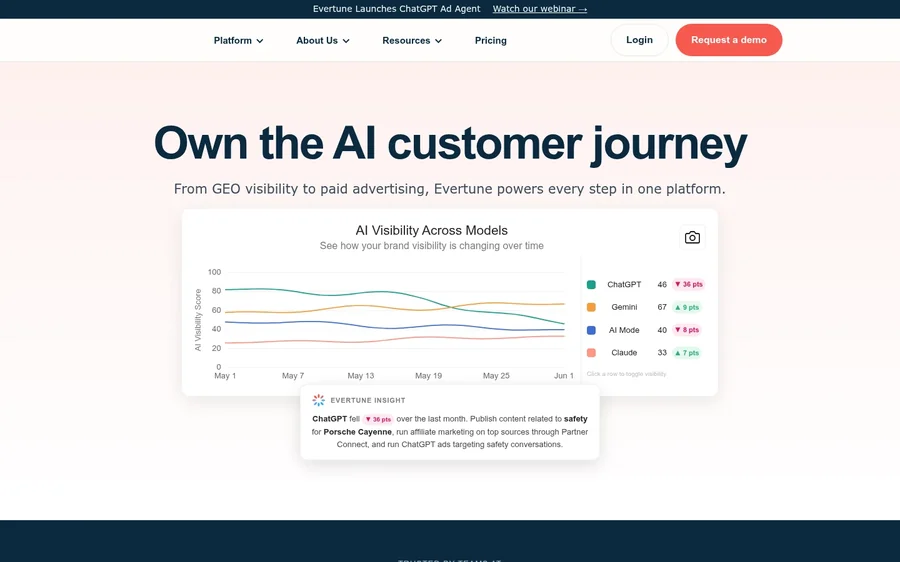
Evertune turns how AI models treat your brand into an AI Brand Score, adding agents that propose next steps.
Best for: brand leaders who trust repeated samples over one harsh answer.
Standout: Evertune samples each prompt up to 100 times per model, so a single odd response doesn’t set the score. An Insights & Action Agent then suggests action steps.
Pros:
- Benchmarks the score against category rivals
- Covers five search models from Starter, Copilot included
- Adds Claude, Perplexity, and Meta AI on Pro
Cons:
- Keeps Fact Checker and data exports for Enterprise
- Frames Starter around ChatGPT ads, not brand accuracy
Pricing: Starter $60 per month; Pro $800 per month billed annually.
At the source: Of these Profound alternatives, Evertune best shows how models place you against rivals. To check one wrong claim against your own facts, plan for the Enterprise tier, where Fact Checker sits.
8. Otterly.AI
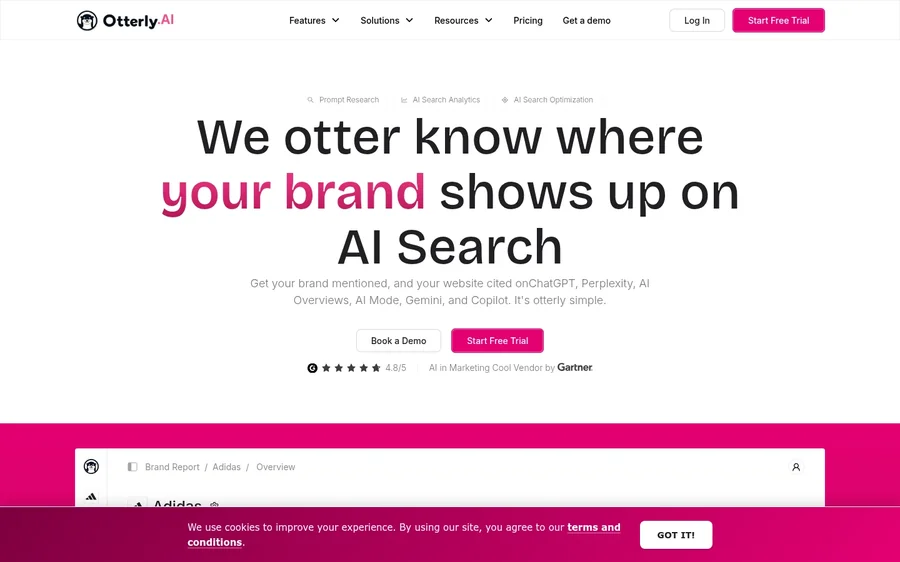
Otterly.AI classifies the sources behind AI answers, showing a brand team what kind of page shapes its description.
Best for: brand teams reading descriptions across many countries and languages.
Standout: Source classification, brand profiling, and sentiment analytics come on every plan, with unlimited brands, competitors, team members, countries, and languages. Each market’s tone and source types sit side by side.
Pros:
- Reports share of voice KPIs
- Profiles traits engines attach to your brand
- Feeds Looker Studio and MCP from Standard
Cons:
- Below Enterprise, plans run 3 of 7 engines
- Lite ships without the API or a Looker Studio connector
Pricing: Lite $29/month with 20 prompts; Standard $189/month; Premium $489/month.
At the source: Source classes point a correction at the right owner before anyone opens a page. Otterly.AI records the pattern; deciding which description is wrong, and briefing content or PR, stays a brand call.
Which Profound alternative should a brand team pick?
If your team must read what an AI answer said about the company, trace that wording to its page, and hand the fix to the page’s owner, start with SE Visible. It shows which source to correct first, not when engines will repeat it.
Of the other Profound alternatives, Peec AI fits a brand-facts checklist; Bluefish, a managed enterprise accuracy program. Where Profound keeps an edge: its Enterprise sentiment view ranks recurring narratives with their source URLs and a perception-versus-reality split. Skip Ahrefs Brand Radar as your only platform if a monthly index refresh is too slow.
The description is the brand now. Test your category prompts in SE Visible before the next brand review. SE Ranking covers the SEO side.
Carry the correction into campaign visuals
If an AI answer repeats a retired product name, check the cited page first. Once the product owner confirms the approved wording, check the assets on that page too: a corrected headline can still sit above a comparison card showing the old name. For teams using template-based image generation, update the shared product-name field and regenerate the affected cards. Review the longest localized name at mobile width before replacing the published images. Record that change separately from the AI recheck so the team can tell what it fixed and what the model still repeats.
Profound alternatives: what brand directors ask
How much does Profound AI cost per month?
There’s no monthly list price for a brand team. Profound offers a free Trial that runs 50 prompts daily for 7 days across ChatGPT, Gemini, and Google AI Overviews, on a fixed industry prompt set, with no history or exports. Continued tracking moves to Enterprise, which is custom-priced.
Which Profound competitors show sentiment in AI answers?
SE Visible reports net sentiment, and any metric opens the actual AI response behind it. Similarweb breaks sentiment down by topic against competitors. The Brand Performance report in Semrush AI Visibility Toolkit assesses tone and attributes, and Otterly.AI lists brand sentiment analytics on every plan.
How long does it take to change how AI describes a brand?
There’s no fixed timeline. It depends on the source: an owned page your web team edits can move faster than a third-party review you can ask to update. Set a recheck date per misconception and judge brand perception across repeated answers, not one.