
Best Email Marketing Agencies for Furniture and Home Goods Brands
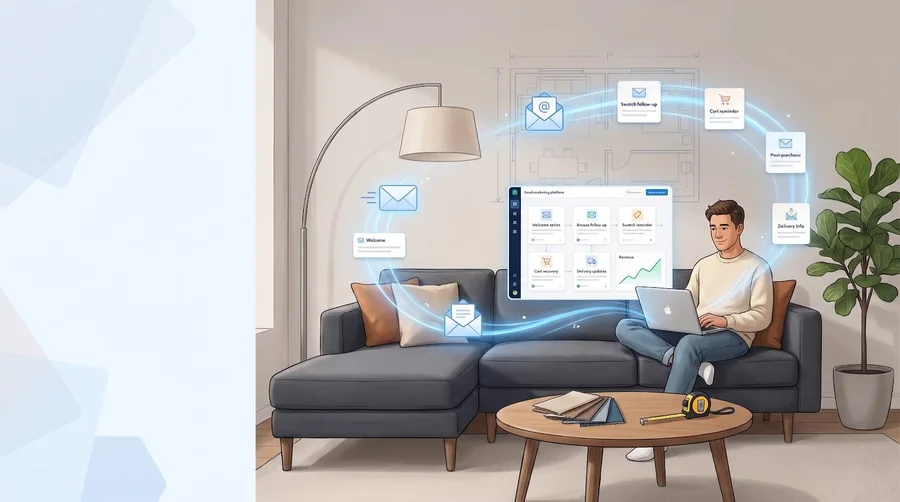
Choosing a sofa is personal: you’re balancing measurements, fabrics, delivery dates, and even partner approval. That careful journey deserves more than a one-size-fits-all promo blast. Automated lifecycle emails (welcome, browse follow-ups, swatch reminders) make up only five percent of sends yet capture almost 41 percent of email revenue, according to Klaviyo’s 2026 benchmarks. The ten agencies below turn that math into profit with proven category results, technical depth, and transparent reporting, so you can spot front-runners fast and dodge costly red flags.
How we chose and ranked the agencies
Finding “the best” looks different for a sofa-in-a-box start-up than for a 50-store chain. We built a rubric that rewards partners who can win in both scenarios, and we weighted each signal so the final score reflects real furniture impact, not generic email promises.
What qualified an agency
Every contender had to pass seven gates:
- Ongoing ownership of email and other lifecycle channels, not one-off templates
- At least one verifiable furniture or home-goods result (named client or timestamped metrics)
- Active service to U.S. merchants as of November 2026
- Coverage of both campaigns and automations
- Demonstrated control of deliverability and authentication
- A public review profile or listing in a recognized partner directory
- No conflicting primary focus (for example, software vendors or paid-media-only shops)
Miss one gate, and the agency dropped to “also considered.”
Our scoring formula
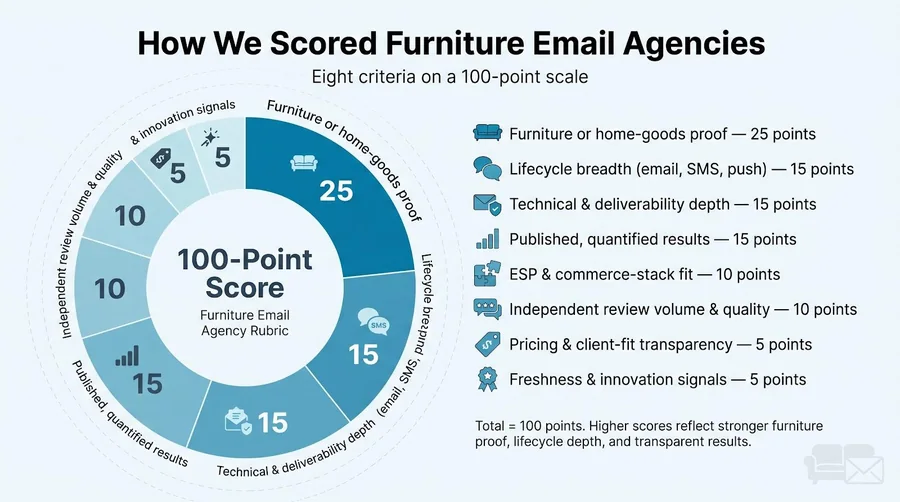
Eight criteria power the 100-point scale:
| Criterion | Weight |
|---|---|
| Furniture or home-goods proof | 25 |
| Lifecycle breadth across email, SMS, and push | 15 |
| Technical and deliverability depth | 15 |
| Published, quantified results | 15 |
| ESP and commerce-stack fit | 10 |
| Independent review volume and quality | 10 |
| Pricing or client-fit transparency | 5 |
| Freshness and innovation signals (awards, acquisitions) | 5 |
When scores tied, we checked, in order, the recency of furniture proof, whether case studies named the client, and how many third-party reviews backed the story.
Reading the scores
A 94 is not universally better than an 83. It simply means that, during research, the higher-scoring firm showed stronger furniture evidence, broader channel control, or clearer reviews. Your tech stack, budget, and in-house resources may reshuffle the list, so use the numbers as a fast filter, then dig into each profile and the question checklist that follows.
Quick snapshot: who ranks where, and why it matters
| Rank | Agency | Best for | Furniture proof | Core channels | Watch-out |
|---|---|---|---|---|---|
| 1 | InboxArmy | Multi-ESP execution & deliverability | Autonomous: +240% revenue on cart rebuild | Email and SMS | Cross-category playbooks |
| 2 | Chronos Agency | Large, international brands | Lifely: email share 26 → 38 percent | Email, SMS, and push | Built for larger programs |
| 3 | Flowium | Broad lifecycle coverage | 256 percent lift (anon décor) | Email, SMS, push, WhatsApp | Case is anonymous |
| 4 | Optimite | Growth-stage retention system | Rugtomize: 4× campaign revenue | Email, SMS, and loyalty | One named home case |
| 5 | CodeCrew | Mixed ESP stacks & custom HTML | Semihandmade: 4× revenue per campaign | Email, SMS, design, dev | Design-led scope |
| 6 | Grow Pronto | High-revenue Klaviyo brands | PatioLiving: $1 M → $1.5 M | Email and SMS | Klaviyo-centred |
| 7 | Siren Partners | Showroom + ecommerce data | +280 percent email revenue (53-location mattress retailer) | Email, SMS, and CRM | Client not named |
| 8 | MH Digital | Custom data feeds & AMP | Kaiyo: custom Klaviyo integration | Email, SMS, AMP | Older furniture case |
| 9 | Kensington Media House | High-AOV retention | +40 percent YoY email revenue (unnamed high-AOV client) | Email, SMS, and CRM | Client not named |
| 10 | Hustler Marketing | Rebuilding from zero | Eternity Modern: $0 → $289 K/mo | Email and SMS | Case started 2019 |
Patterns to note:
- Each leader publishes concrete furniture revenue, not a vague “home brands” claim.
- Deliverability and authentication expertise remain vital because spam-rate ceilings are unforgiving.
- Review volume varies widely, and a boutique with a small review base can still outperform a giant if its proof is fresher and more detailed.
Short-list two or three contenders, then continue to the deep-dive profiles for nuance no one-screen table can capture.
1. InboxArmy: best for multi-ESP execution, deliverability, and dedicated resources
Texas-based InboxArmy focuses solely on email and SMS, so every strategist, designer, and developer speaks retention first.
Furniture proof is concrete. Ergonomic office furniture brand Autonomous saw +220 percent conversions and +240 percent revenue on its cart rebuild, clear evidence of deep automation rather than one-off blasts.
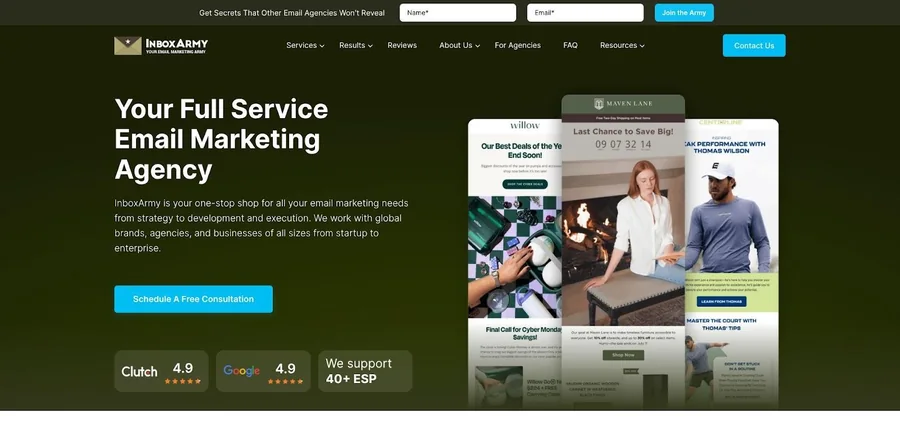
InboxArmy homepage screenshot for furniture lifecycle email services.
Platform breadth is a selling point. Whether you run Klaviyo, Salesforce Marketing Cloud, HubSpot, or another ESP, InboxArmy handles migrations, responsive template builds, authentication fixes, and weekly performance huddles inside one retainer.
Social proof backs up the numbers: 71 verified Clutch reviews averaging 4.9 out of 5 signal repeatable performance, not a single lucky win.
The agency serves brands across more than 25 industries, so furniture teams benefit from lifecycle lessons tested across categories. For merchants who want senior email and SMS firepower across any ESP, InboxArmy tops the shortlist.
2. Chronos Agency: best for large, international furniture brands
If your catalog crosses borders and your list tops a million subscribers, Chronos is built for you. The team handles strategy, creative, and performance for brands that ship sofas from Sydney to Seattle.
Furniture proof is concrete. For Lifely, an Australian furniture brand, Chronos raised email’s share of total store revenue from 26 percent to 38 percent after adding eight flows and reworking campaigns and segmentation, with flow and campaign shares both rising.
Chronos runs Klaviyo programs and adds SMS and push notifications alongside email.
The trade-off is scale: smaller retailers may need less than a full program. Eight-figure, multi-region brands, however, often see Chronos turn inbox complexity into reliable monthly revenue.
3. Flowium: best for brands that want every lifecycle channel under one roof
Flowium treats retention as a single system. Email, SMS, WhatsApp, RCS, web push, and even direct mail each have a defined role, all driven by one central lifecycle plan.
Proof of impact: an anonymous but fully documented home-décor client grew attributed email revenue from $7,000 to more than $25,000 in four months, a 256 percent lift, after Flowium built targeted automations and refreshed the email design.
Client reviews on its site describe Klaviyo migrations from Mailchimp, Listrak, and Bronto, and deliverability is one of its listed services.
One watch-out: the headline case study omits the brand name. Ask for a second, named furniture reference if confidentiality is a concern. If you value multichannel depth, Flowium offers a full retention toolkit in one place.
4. Optimite: best for growth-stage brands that want one connected retention program
Optimite focuses on retention for growing brands that need to replace ad-hoc “hustle emails” with a true retention engine.
Furniture proof is strong. Custom-rug seller Rugtomize grew campaign revenue four times in 12 months after Optimite built its retention program from scratch.
Services go wider than flows alone. The agency unifies email, SMS, loyalty tiers, subscription retention, and deliverability hygiene so every message, point, and reward draws from the same data spine. It is a Klaviyo Master Platinum partner with six years on the platform.
Clutch reviews quoted on its site praise on-time delivery and project management.
For U.S. furniture sellers in growth mode, it brings a home-specific retention playbook and a stack that talks to itself.
5. CodeCrew: best for design-centric brands on mixed ESP stacks
CodeCrew blends standout creative with serious technical muscle. If your cabinet-door line lives on Salesforce Marketing Cloud today and Klaviyo tomorrow, the developers bridge that gap without breaking HTML or inbox placement.
Furniture proof is real. Semihandmade saw a 4x increase in average revenue per campaign after CodeCrew overhauled design and segmentation, and CodeCrew moved Semihandmade and its sister brand Boxi to Klaviyo in record time.
Platform agnosticism sets the agency apart. The team works across Klaviyo, SFMC, Braze, HubSpot, and Attentive, and offers deliverability and inbox performance tracking as services.
Its case study also reports a 705 percent rise in Semihandmade’s quarterly revenue by the end of the second quarter.
6. Grow Pronto: best for high-revenue Klaviyo furniture brands
If your Klaviyo dashboard already shows seven-figure monthly revenue, incremental tweaks will not cut it. Grow Pronto specializes in the big structural changes that unlock the next half-million.
Flagship proof: PatioLiving, a multi-eight-figure furniture brand, lifted monthly Klaviyo revenue from about $1 million to $1.5 million, with 51 percent of revenue now coming from Klaviyo. Grow Pronto doubled pop-up conversion from 2 to 4 percent, lengthened flows from three to six emails, and added Retention.com, which lifted flow revenue 23 percent (about $1.2 million a year).
Scope stays tight: email and SMS strategy, creative, segmentation, forms, and reporting.
Its published case studies focus on seven-, eight-, and nine-figure brands.
Its work centres on Klaviyo. For furniture brands chasing mature-stage growth, Grow Pronto delivers outsized gains without diluting focus.
7. Siren Partners: best for marrying showroom data with ecommerce journeys
Most agencies treat point-of-sale data as a black box. Siren Partners opens it, connecting in-store purchases and rewards data to Klaviyo or Salesforce so follow-ups stay seamless whether a shopper clicks “Add to Cart” or swipes a card in person.
Flagship proof: a 53-location mattress retailer recorded a 280 percent increase in email revenue with Siren, a client it has retained for more than two years.
Services span in-store to online profile stitching, email and SMS campaigns and flows, ESP migration, creative, and reporting.
Caveat: the headline case does not name the client, so request references and sample scopes.
If you operate multiple stores and your ecommerce list feels disconnected, Siren Partners brings the integration muscle many boutiques skip.
8. MH Digital: best for custom data feeds and AMP
Some catalogs change daily, not seasonally. MH Digital thrives in that pace, handling dynamic content and custom integrations that standard email builders struggle with.
Furniture proof: MH Digital lists a case study for Kaiyo, a pre-owned furniture marketplace, covering flow and campaign strategy on a custom Klaviyo integration that delivered growth during the pandemic.
Technical strength extends beyond feeds. The team codes AMP, dark-mode, and dynamic-content emails for whichever platform a brand uses.
Client reviews on its site describe it as more partner than agency.
Downside: the Kaiyo case dates from the pandemic years, so ask for a fresher furniture reference if recency matters. For brands wrestling with complex catalogs or marketplace data, MH Digital’s tooling often pays for itself.
9. Kensington Media House: best for high-AOV retention
High-ticket products sell slowly, and Kensington Media House builds retention programs for exactly that: considered purchases with long sales cycles and order values of $400 and above.
Proof: for a high-AOV client it does not name, Kensington reports 40 percent year-over-year email revenue growth, November revenue up 84 percent (£5 million to £9 million) across two Black Fridays, and open rates up from 18 to 46 percent in three months.
Services span email, SMS, CRM optimisation, and retention strategy, and for high-AOV brands it avoids discount-led tactics.
Ask for a named furniture reference, since the headline results are anonymous.
If your products are high-ticket and rarely repurchased, Kensington’s playbook fits.
10. Hustler Marketing: best for rebuilding a neglected furniture email program
When your inbox revenue flat-lines, Hustler Marketing brings it back to life. Its flagship case started from zero email revenue.
Flagship proof: Eternity Modern grew from zero email contribution to $289,000 in monthly revenue within 11 months, with email bringing in 40 percent of store revenue. The lift came from nine new flows (welcome, browse abandonment, add to cart, cart abandonment, post-purchase, upsell, and win-back among them) plus a steady cadence of campaigns that kept mid-century shoppers engaged.
The case study also covers domain warm-up and spam-filter work to keep those emails in the inbox.
One caution: the Eternity Modern engagement began in 2019, so request a fresher furniture reference to confirm the playbook still matches 2026 inbox rules.
For founders who ghosted their list or migrated ESPs without rebuilding flows, Hustler Marketing supplies the jump-start that turns email from expense to profit center.
What furniture and home-goods brands need from an email agency
A sofa rarely moves from browse to checkout in a single visit. Shoppers measure walls, order swatches, and debate finishes for weeks, so email has to sustain a long, high-consideration journey, not blast discounts and hope.
A lifecycle built for long decision windows
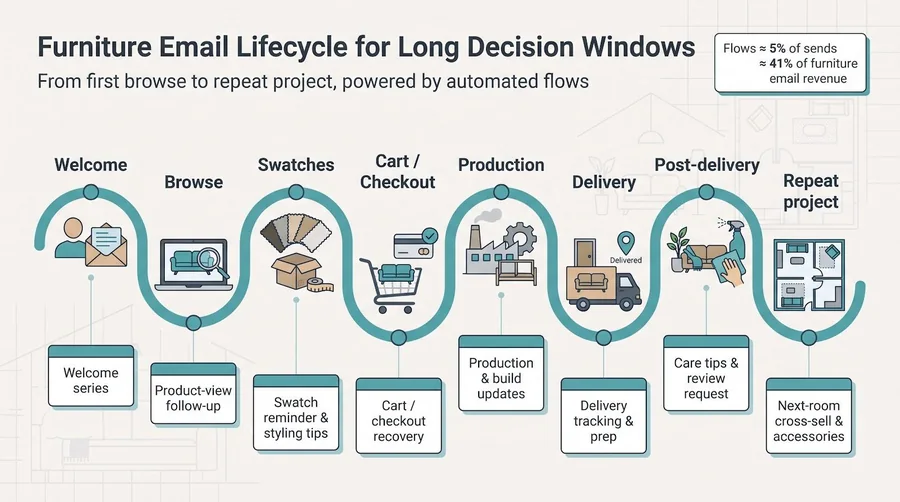
Klaviyo’s 2026 benchmarks show automated flows make up five percent of sends yet capture nearly 41 percent of email revenue. That revenue-per-send edge flips priorities: welcome, product-view, swatch, cart, and post-purchase sequences must run continuously, while campaigns handle launches and seasonal stories.
Key adjustments
- Capture style, room, or project intent at sign-up so messages stay relevant for weeks.
- Stretch browse- and cart-abandonment flows over several days, answering fit, financing, and delivery questions before offering discounts.
- Use post-purchase milestones (production start, quality check, freight pick-up) to replace anxiety with anticipation.
Product confidence content that answers “Will this fit?”
Baymard’s 2026 survey of 1,598 U.S. furniture and home decor shoppers found 49 percent named written dimensions and 42 percent a dimensions drawing as the content that gives them fit confidence. Put those elements inside browse and cart flows, not just on product pages. Reusable modules (three-bullet spec blocks, 360-degree GIFs, room-scale comparisons) let every message remove doubt without adding weight.
The automation blueprint to steal
- Welcome journey: captures room, budget, style, and delivery window.
- Product-view follow-up: fit visuals, delivery timelines, and financing options.
- Category abandonment: comparison guides and real-home photos.
- Cart / checkout abandonment: three to five touches over 24 to 72 hours for high-AOV items.
- Swatch or sample follow-up: match pieces and set delivery expectations.
- Production and delivery series: order confirmed › build progress › dispatch › scheduling › care tips.
- Review and photo request: seven to ten days post-delivery.
- Next-room cross-sell: complementary pieces after initial satisfaction.
- Accessory or seasonal reactivation: warm the list six weeks before tent-pole events.
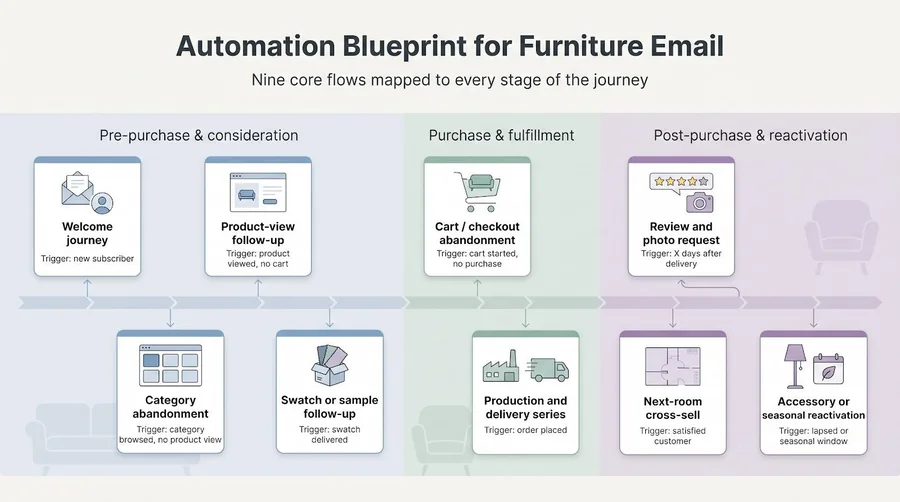
Map these flows with triggers and exit criteria so everyone, agency and in-house, knows who speaks to the customer and when.
Bridging showroom visits and online carts
Pass POS consent, SKUs, and store location to your ESP within minutes. Follow-up emails can thank someone for visiting Elm Street, tag them for local back-in-stock alerts, and attribute revenue to both online and in-store purchases. Segment showroom visitors separately from pure online traffic; the first group needs care tips for the piece they tested, the second needs delivery-route answers.
Delivery emails that drive loyalty
For bulky items the sale is not over until the sofa clears the doorway. Sequence: order confirmation with timeline → scheduling link → “On the way” prep list → post-delivery care guide → 30-day check-in with accessory bundle. This cadence turns logistics into a loyalty moment and sparks repeat orders.
What should be included in the agency scope?
A scope of work is more than a task list; it is insurance that strategy, production, and deliverability stay aligned long after kickoff.
Strategy and discovery set the tone
- Full lifecycle audit that maps every current touchpoint and benchmarks performance by flow, campaign, and segment.
- Deliverability review (SPF, DKIM, DMARC, list hygiene, complaint history).
- Purchase-cycle analysis to uncover seasonality, first-to-second-order lag, and margin by product line.
- A single reporting framework (revenue per recipient, placed-order rate, repeat purchase rate) agreed before production starts.
Campaign production without inbox fatigue
- One-page storyboard for each send (subject, hook, hero, CTAs, dynamic blocks).
- Responsive images, dark-mode-safe HTML, and Outlook fallbacks.
- Dedicated QA for links, rendering, and inbox placement; sending pauses if complaints spike.
- Shared calendar so campaigns, flows, and SMS never overlap.
Automation: the profit engine
- Build and document the foundational set: welcome, product-view, category, cart, checkout, post-purchase, review, and win-back.
- Furniture extras: swatch follow-up, price-drop alerts, and delivery milestones.
- Ninety-day optimisation cycle covering subject tests, segmentation tweaks, dynamic content, and plain-text nudges.
- Live flow map with triggers, delays, and exit rules stored in a cloud doc everyone can access.
Deliverability before design
Google asks senders to keep their spam rate below 0.1 percent and never let it reach 0.3 percent. Your scope should include:
- Authentication audits (SPF, DKIM, DMARC) before the first send.
- Ongoing reputation checks in Google Postmaster Tools and Microsoft SNDS.
- Bounce and complaint thresholds that auto-pause campaigns.
- Warm-up plans for new domains or IPs.
- Quarterly list-hygiene runs.
SMS and push: urgency with restraint
- Define use cases (delivery scheduling, back-in-stock, limited-time access).
- Frequency caps (two to four texts per month unless opted into logistics updates).
- Shared suppression logic so texts do not repeat what an email just said.
- One combined dashboard for revenue, opt-ins, and churn.
Reporting: one dashboard to rule them all
- Core KPIs: revenue per recipient, placed-order rate, and repeat purchase rate.
- Separate flow and campaign columns; flows earn far more per send than broadcasts.
- Holdout tests for lists over 100,000 contacts to prove incremental lift.
- Gross-profit overlay using product-cost data.
- Deliverability, list growth, churn, and accessory attach rate on the same screen.
How much does an email marketing agency cost?
Few agencies publish full rate cards, and scope, not rate cards, ultimately drives the bill.
Typical full-service retainers for furniture brands fall into three bands:
- Boutique growth package. One strategist, a part-time designer, four to eight campaigns, basic flows, and quarterly optimization, ideal for smaller brands.
- Mid-market program. Dedicated strategist, designer, and developer; weekly campaigns; full automation suite; SMS integration; and a monthly testing roadmap, the sweet spot for mid-sized sellers.
- Enterprise engagement (custom SOW). Multiple strategists, an account manager, creative pods, direct developer access, in-house deliverability specialist, and omnichannel attribution, built for eight-figure, multi-region operations.
Beyond the retainer, four cost centers trip up first-time buyers:
- Audit fees. Some agencies waive them for new retainers; others charge for a deep dive.
- Deliverability remediation. List cleaning, warm-ups, and spam-trap removal often come as a separate fee.
- ESP migrations. Moving from Mailchimp to Klaviyo or Salesforce is often a separate project once product feeds and history are mapped.
- Revenue-share bonuses. Some partners layer a share of attributable email revenue on top of base fees. Cap the percentage and tie it to incremental lift, not platform attribution alone.
Remember, the ESP bill is separate. Klaviyo’s price scales with list size and SMS credits; bake that into budgets so finance is not blindsided.
Finally, treat any “minimum project size” as an entry ticket, not a monthly fee. InboxArmy lists a $1,500 per month minimum, no hidden fees, no long-term lock-ins. The real quote flexes with list size, creative volume, and how many flows the team rebuilds in month one. Always request a detailed scope with line-item hours so you can compare apples to apples across proposals.
Questions to ask on every discovery call
A glossy sales deck can impress, but the right questions reveal whether an agency can repeat its best work for your brand. Bring this checklist with you.
- Show us a recent furniture or home-goods case with numbers and dates. Screenshots beat adjectives.
- How will you adapt cart timing for a 30-day purchase cycle? Look for segmentation logic, not “send sooner.”
- What share of our email revenue should come from flows, and why? Credible answers cite benchmarks and adjust for your AOV and list size.
- How do you measure incremental lift? Holdouts or geo-tests trump platform attribution.
- Who will work on our account after kickoff, and how many accounts does each strategist handle? Names and ratios reveal focus.
- Which tools monitor deliverability each week? Expect Google Postmaster, Microsoft SNDS, and seed-testing suites.
- How do you coordinate email, SMS, and push frequency? One calendar, shared suppression lists, and a channel hierarchy prevent fatigue.
- Can you connect showroom POS data with online behaviour? Essential for retailers with physical locations.
- What is included versus billed separately? Migration, list cleaning, and design overages often hide in fine print.
- Who owns the ESP account, creative files, and reporting dashboards if we part ways? Ownership avoids hostage situations.
- What are the notice and cancellation terms? Ninety-day locks hinder agility; month-to-month shows confidence.
- How will you protect gross margin during sale seasons? Value-add bundles and smart segmentation beat blanket discounts.
- What happens after the initial flow rebuild? Ongoing testing plans separate growth partners from project shops.
- How do you govern AI-generated content? Ask about human review, brand-voice checks, and hallucination safeguards.
Red flags to avoid when vetting an agency
Some red flags whisper; others shout. Spot them early, and you protect both budget and inbox reputation.
- Guaranteed revenue before an audit. Furniture margins swing with freight rates and promos; claims like “we’ll drive 40 percent of sales” ignore that reality.
- Badge bragging without case studies. A Klaviyo Elite logo shows volume, not vertical skill. No named furniture proof? Move on.
- Reporting that stops at open rate. Opens are directional at best; insist on placed-order, revenue-per-recipient, and lift from holdouts.
- Identical three-email flows for every brand. High-AOV items need longer nurtures and delivery education; cookie-cutter sequences leave money unearned.
- Junior hand-off after the pitch. If a senior sells the deal but interns run the work, request named team members in the contract.
- Silence on deliverability. Agencies unable to discuss SPF, DKIM, complaint thresholds, or list hygiene will not keep you in the inbox.
- No AI governance plan. In 2026, partners should detail how human review, fact checks, and brand-voice controls tame AI-generated content.
2026 and 2027 trends furniture email marketers can’t ignore
AI-assisted shopping raises the bar on personalisation
Sixty-eight percent of U.S. consumers surveyed used a general AI chatbot for shopping, and 92 percent of those AI users subscribe to brand email, compared with 72 percent of non-users (according to Attentive’s 2026 State of AI in Retail report). They arrive primed for relevance and unforgiving when brands forget what they browsed yesterday.
Clean, machine-readable product feeds (dimensions, materials, lead times, care notes) let both the chatbot and your ESP surface accurate details. Ask any agency which catalogue fields power its templates, how AI-generated copy is fact-checked for brand voice and accessibility, and which human signs off. AI is a co-pilot, not an autopilot.
AI-generated content demands bullet-proof QA
Generative tools can crank out subject lines and templates in seconds, but hallucinated fabric names or wrong lead times erode trust fast.
- Human in the loop. AI drafts → strategist verifies facts → writer polishes tone → QA checks accessibility and spam triggers.
- Brand-voice and compliance guards. Prompts should include tone rules; legal claims must route for review.
- Performance tracking. Compare revenue per recipient and complaint rate for human-only versus hybrid copy; roll back if AI underperforms.
3D and AR lift fit confidence when email points to the experience
When a shopper wonders whether a sectional dwarfs a studio, no image beats a true-scale AR model. Shopify, Adobe, and standalone render platforms make AR table stakes, yet many brands hide the feature behind a tiny page link.
- Add a 360-degree GIF or hero image with a clear “View in my room” button that deep-links to mobile AR.
- On desktop, route the click to an interactive 3D spin, no plug-ins required.
- Provide fallbacks: a dimension graphic or “same width as a queen bed” comparison for devices that cannot load WebAR.
- Track click-to-AR-view rate alongside revenue to prove value.
Executed well, each message turns curiosity into conviction and shortens the path from inbox to “Buy.”
Frequently asked questions
What is the best email marketing agency for a furniture brand?
There is no universal winner. InboxArmy tops our scorecard for multi-ESP execution and deliverability, Chronos fits eight-figure, multi-region programs, and Siren Partners excels when showroom data must sync with ecommerce. Short-list agencies whose past cases mirror your own challenges.
How long does it take to see results?
Quick wins such as reclaimed abandoned-cart revenue can appear within the first few weeks. Sustainable lifts usually take a few months, once new automations mature and list growth kicks in. Longer purchase cycles or serious deliverability fixes stretch timelines, so build a buffer into forecasts.
How many emails per week is too many?
For high-AOV furniture, one campaign and one automation touch per segment per week keep engagement high without fatigue. During tent-pole events you can send more if you tighten suppression rules for recent openers and purchasers; let engagement data guide cadence.
Do partner badges guarantee quality?
No. A Klaviyo Elite or Platinum badge confirms volume and training, not furniture expertise, creative taste, or margin discipline. Treat badges as qualifiers, then insist on named vertical proof and live references.
Should small brands hire an agency or a freelancer?
If online sales are below roughly $1 million a year, a project-based freelancer who rebuilds critical flows and templates is often smarter than a full retainer. Once revenue and list size support weekly campaigns and multichannel coordination, an agency delivers stronger ROI.
How do we measure agency performance?
Anchor on revenue per recipient, placed-order rate, and repeat purchase rate. Add gross-profit reporting, list growth, churn, and inbox placement for a 360-degree view. For lists over 100,000 contacts, run quarterly holdouts to prove incremental lift, not just attributed dollars.
Can one partner handle email, SMS, push, and deliverability?
Yes, if the scope spells out shared frequency caps, list ownership, and a single reporting layer. Most agencies in our top ten manage those channels, yet you still need to probe their workflow to ensure cohesion.
Make visual production part of the agency handover
Furniture email programs need a repeatable way to produce product cards, collection headers, swatch reminders, and accessory recommendations. Ask the agency to deliver editable templates alongside finished campaign files, with documented fields for product imagery, approved copy, prices, and offer dates. This makes the creative system easier to maintain when a collection changes or responsibility moves in-house.
Pixelixe can supply the visual production layer through reusable layouts populated with structured inputs. The agency or ESP should still manage audience eligibility, consent, scheduling, and sending. A useful starting point is Pixelixe’s guide to dynamic images for email personalization, which explains how product and lifecycle data can inform branded email visuals.
Pilot the workflow with one collection and a few lifecycle messages. Check product accuracy, readable mobile text, valid offers, and fallback images before expanding. Keep essential prices and conditions in the email’s readable text as well. Measure production time and correction rates alongside campaign results; faster exports alone do not demonstrate better customer outcomes.
Conclusion
Furniture email wins on relevance, not sheer send volume. Timely automations, confidence-building content, and rock-solid deliverability separate leaders from list-burners. The agencies above prove those fundamentals at every scale:
- InboxArmy for multi-ESP execution and inbox placement
- Chronos for eight-figure, multi-region complexity
- Flowium for full lifecycle across every channel
- Optimite for growth-stage structure
- CodeCrew, Grow Pronto, Siren Partners, MH Digital, Kensington Media House, and Hustler Marketing for specialised creative, technical, or integration strengths
Match their capabilities to your reality: budget, tech stack, in-house bandwidth, and growth goals. Then request scopes and references. Choose the partner that treats a sectional launch with the same care as a peak-season promo, and the revenue will follow long after the delivery truck pulls away.