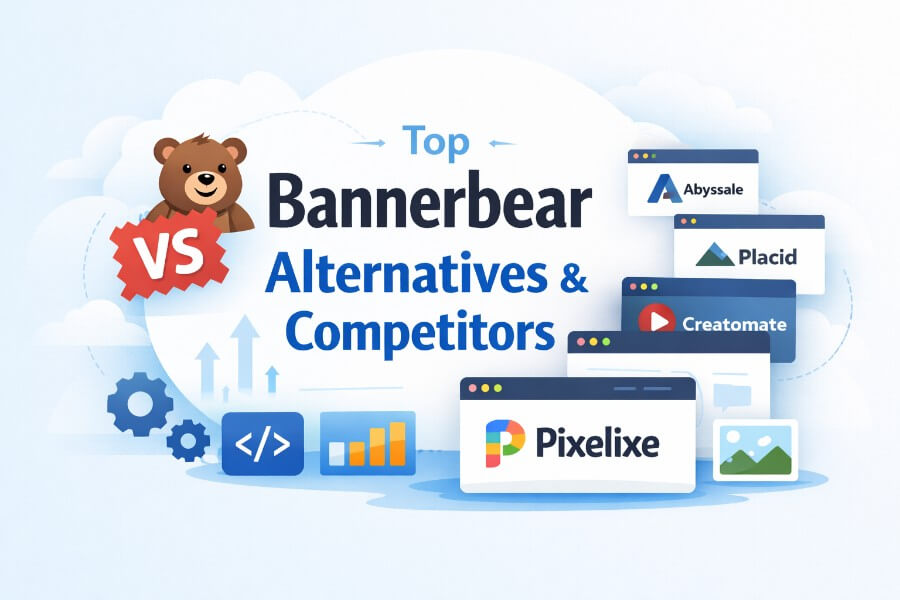
Looking for a Bannerbear alternative that fits the way your team actually works?
Most teams start comparing tools when simple image rendering is no longer enough. The real question is not just “Which tool can generate images?” It is “Which tool lets marketers, ecommerce teams, and developers update templates, launch variations, and keep production moving without friction?”
This comparison keeps the focus on workflow: template control, automation depth, and who can operate the system day to day. If your team needs a broader view of production workflows, it also helps to review ways to automate AI image generation and how brands create visuals at scale.
Comparison table
| Tool | Workflow style | Automation angle | Best for | Watch for |
|---|---|---|---|---|
| Pixelixe | Visual template editor plus API and bulk generation | Strong fit for template-based image generation, resizing, and repeated campaign output | Marketing teams, ecommerce teams, SaaS products | Best value shows up when you need recurring production, not one-off design work |
| Abyssale | Creative automation platform for larger team workflows | Strong fit for structured campaign operations | Agencies and larger marketing teams | Heavier setup can be harder to justify for lean teams |
| Placid | Lightweight templated generation workflow | Good fit for simpler automation needs | Startups and smaller product teams | May feel limited if your process depends on deeper marketing operations |
| Creatomate | Developer-oriented rendering workflow | Good fit when engineering owns the pipeline | Product teams building media generation into software | Template iteration can be slower for non-technical users |
| Canva | Manual-first design workflow | Useful for manual design production, less focused on automated generation | Small teams designing assets by hand | Less aligned with teams that need repeatable, API-led output |
What to compare before switching from Bannerbear
Before you compare tools feature by feature, define the production problem you are solving:
- Do marketers need to update templates without waiting on developers?
- Do you need one image at a time, or hundreds of localized or campaign-specific versions?
- Do you need a reusable template system, not just prompt-based generation?
- Do you need approval and review steps before final export?
- Do you need the same creative adapted across channels and sizes?
Those questions matter more than a long checklist. A tool that is great for developer-owned rendering may still be a poor fit for a merchandising team that updates homepage banners every week.
1. Pixelixe
Pixelixe is the closest fit when your process depends on both template editing and automation. It is built for teams that want to design once, then generate many variations through APIs, feeds, or repeatable production workflows.
That makes it especially useful for:
- ecommerce teams updating product, promo, and category banners
- SaaS teams generating templated visuals from structured data
- growth teams that need fast resizing and campaign variation output
- platforms embedding a white-label editor alongside automation
If your workflow sits between marketing operations and engineering, Pixelixe usually makes more sense than a rendering-only stack. It also pairs naturally with creative automation campaign use cases and auto-generated social graphics from API workflows.
2. Abyssale
Abyssale is a reasonable option for teams that think in terms of campaign operations, approvals, and repeated creative output across a larger organization. It tends to make more sense when multiple stakeholders touch the production workflow and automation needs to sit inside a broader team process.
3. Placid
Placid is easier to consider when you want a lighter automation layer around templated image generation. It is a practical choice for teams that do not need a large creative-ops setup and want a simpler path to automated visuals.
4. Creatomate
Creatomate is more naturally positioned for developer-led media generation. If engineering owns the rendering system and wants tighter programmatic control, it can be a sensible direction. The tradeoff is that template iteration may become less comfortable for non-technical users.
5. Canva
Canva is often part of this conversation because many teams move between manual design tools and automated generation tools. It works well when the priority is speed in manual design, team familiarity, and broad template access. It is less compelling when your main requirement is repeatable image generation tied to data, feeds, or product logic.
Best fit by team type
For ecommerce merchandising teams
Choose the option that makes product swaps, price updates, seasonal versions, and channel resizing easy. That is where template systems and bulk generation matter most.
For SaaS and product teams
Choose the option that fits how structured data flows into your visuals. If the goal is automated output from your application, developer workflow and API flexibility matter more than design-library breadth.
For performance marketing teams
Choose the option that helps you generate variants fast, update messaging without bottlenecks, and keep template governance tight across campaigns.
For content and social teams
Choose the option that reduces manual resizing and repetitive design work while keeping the editing process simple enough for day-to-day use.
When Pixelixe is the better fit
Pixelixe is usually the stronger fit when:
- marketers need to edit templates visually
- developers still need an API for automated generation
- ecommerce teams must produce many banner versions from the same template
- brand consistency matters across multiple sizes and channels
- creative production needs to scale without turning every update into a design ticket
If that sounds like your environment, Pixelixe is worth testing on a real campaign rather than comparing tools only at the feature-list level.
FAQ
What should I compare first when replacing Bannerbear?
Start with workflow ownership, not a feature list. The biggest differences usually show up around template editing, bulk generation, and how easily marketers can operate the system without engineering bottlenecks.
Do I need AI image generation, or just template automation?
Many teams need template automation more than open-ended image generation. If your work is campaign banners, product visuals, and repeatable branded assets, structured templates are usually the better foundation.
A practical next step
If your current setup is slowing down template changes, campaign resizing, or bulk visual generation, test your shortlist against one real workflow such as localized banners, product-feed graphics, or social variations. If that workflow needs both visual template editing and automation, Pixelixe is one of the stronger fits to evaluate.