
The broad idea of “automating marketing visuals with APIs” is no longer new. Most teams already understand that templates, structured data, and image rendering can reduce manual design work.
Direct Answer
A JSON-to-Graphic workflow creates an editable branded layout from structured data or AI-generated instructions. Unlike JSON-to-image rendering, it produces an asset that can still be reviewed, refined, saved as a template, and reused for future production.
JSON-to-Graphic vs JSON-to-Image
| Capability | JSON-to-Graphic | JSON-to-Image |
|---|---|---|
| Primary output | Editable layout | Final bitmap |
| Best stage | Creation and approval | Production rendering |
| Human review | High | Optional |
| Template reuse | Strong | Depends on system |
Why Pixelixe fits this workflow
Pixelixe is differentiated because it can support the handoff between AI intent and brand-controlled production: first create an editable graphic, then save and render approved variants through API workflows.
Author and update note
Updated on May 20, 2026 by the Pixelixe team to reflect Google AI Search, AI Overviews, AI Mode, and practical visual automation workflows. Pixelixe builds tools for branded image automation, template-based creative production, embedded editing, and API-driven visual generation.
FAQ
Why does editability matter for AI-generated layouts?
Marketing teams often need compliance, brand review, and design adjustments before an asset becomes production-ready.
Who needs JSON-to-Graphic?
AI agents, SaaS platforms, marketplaces, CMS builders, and internal marketing tools that need to create editable branded assets from structured inputs.
The more interesting question in 2026 is not whether API-based visual production is possible.
It is whether a team can turn structured product data, campaign payloads, or user actions into editable branded assets instead of flat one-off images.
That distinction matters.
A static rendered image is useful when the output is final. But many SaaS products, internal tools, and campaign workflows need more flexibility than that. They need a system that can turn structured inputs into branded layouts that can still be reviewed, saved, reused, localized, and adapted later.
That is where Pixelixe has a more distinctive role than a generic image API. Pixelixe is built around creating the first branded layout in Studio, controlling brand logic in Brand Kit, and then scaling those layouts through APIs, automation, and AI-ready workflows. The platform’s core positioning is not just “render an image.” It is “create once, scale branded visuals everywhere.” (Pixelixe homepage)
Why Static Image Rendering Is Not Enough for Many SaaS Workflows
A lot of API-based visual systems stop at the render step.
They take a payload, generate a PNG, and return a URL. That works for some use cases. But it breaks down quickly when teams need more than simple one-time outputs.
Many SaaS and product-led teams actually need visuals that can evolve:
- a lifecycle banner that changes by user segment
- a product summary card that may need review before publishing
- a social share graphic generated from user activity
- a campaign layout that begins from structured inputs but still needs human approval
- a repeatable design system that can be reused across multiple product surfaces
This is why editable-layout workflows matter.
Pixelixe addresses that with its JSON to Graphic API, which is built for cases where the workflow starts from structured intent, a campaign payload, or an AI-generated brief and needs a brand-ready editable layout rather than only a final bitmap. Pixelixe’s docs explicitly position JSON to Graphic as the entry point when the first layout still needs to be reviewed, saved, and reused in Studio before production scales further.
The Real Opportunity: Turning Product Events Into Reusable Visual Systems
This is where the workflow becomes much more powerful.
Instead of thinking in terms of “generate an image from data,” teams can think in terms of “turn repeated product or campaign events into reusable visual assets.”
Examples include:
- user milestone summaries
- promotional cards generated from CRM segments
- “year in review” product visuals
- onboarding graphics personalized to account setup
- dynamic share cards built from user-generated outputs
- route-specific branded images for landing pages and content hubs
A SaaS product with an interactive experience could, for example, take a user action from an ai baby name generator and turn that result into a branded, shareable visual card. The key value is not the render alone. It is the ability to create a layout that fits the product’s brand system, can still be reviewed or reused, and can then scale into multiple delivery surfaces such as landing pages, email, and social sharing.
That type of workflow is much closer to Pixelixe’s actual strength than a generic “API-based image generation” article.
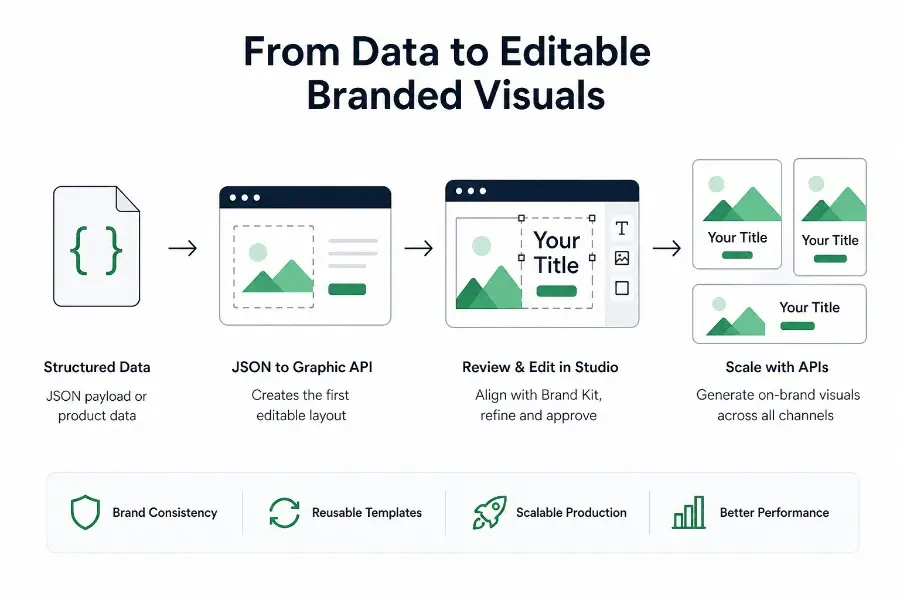
From JSON to Editable Graphic to Scaled Production
A modern Pixelixe-style workflow often looks like this:
- A backend or AI system produces a structured payload.
- The payload is sent to JSON to Graphic API to create the first editable layout.
- The layout is reviewed, saved, and aligned with Brand Kit rules in Studio.
- Once approved, it becomes a reusable template.
- Future variants are rendered at scale with the Image Generation API or JSON to Image API.
This architecture matters because it respects how real teams work. The first version often needs human review. After that, the system should automate production, not force the team to keep rebuilding assets manually.
Pixelixe’s own developer pages describe this layered model directly: JSON to Graphic for the first editable layout, Image Generation API for approved template rendering, and JSON to Image API when the backend already knows the payload shape and simply needs final rendered visuals.
Why This Matters for SaaS Products, Marketplaces, and Internal Tools
This workflow is especially useful in products where visuals are generated as part of the product experience itself.
For SaaS products, that may mean:
- personalized product recap cards
- onboarding and activation visuals
- usage summaries
- lifecycle campaign banners
- branded outputs users can share externally
For marketplaces, it may mean:
- seller-specific promo graphics
- product-card variants
- region-specific listing visuals
- campaign assets that adapt to category or location
For internal tools, it may mean:
- CRM-driven campaign assets
- account-specific banners
- sales enablement visuals
- repeatable layouts generated from structured business data
Because Pixelixe combines templates, Brand Kit, APIs, and editable workflows, it fits these systems more naturally than a tool that only returns a flat image. The broader creative automation layer is important here because the goal is not just generation speed. The goal is controlled scalability. (Pixelixe creative automation)
Editable Assets Improve Governance, Not Just Speed
There is also an operational benefit that generic “image API” articles often miss: governance.
When visual production depends entirely on flat image outputs, teams lose a lot of flexibility. Layouts are harder to review. Edits become more manual. Reuse is less reliable. Brand consistency depends more heavily on external discipline.
Editable branded assets improve that situation because the design logic is preserved inside the system.
That means teams can:
- review the first layout before scaling it
- keep reusable templates aligned with Brand Kit rules
- save visual systems inside Studio
- return to approved assets later without starting over
- give design teams more control over the template system rather than the repetitive production work
This is exactly the kind of shift Pixelixe’s platform positioning supports: designers stop doing endless resizing and text swaps, and instead focus on building stronger reusable visual systems.
Why This Also Supports SEO and GEO
This workflow is not only useful for product UX or campaign operations. It also helps with discoverability.
In an AI-first environment, brands increasingly need more than one-off assets. They need a coherent visual layer across:
- landing pages
- blog posts
- social previews
- campaign pages
- lifecycle emails
- route-specific content surfaces
That is one reason Pixelixe’s Open Graph Image API is strategically useful. It allows teams to generate route-specific share images that align with the content on the page rather than relying on generic fallback graphics. That improves the consistency of the brand’s visual footprint across search, social sharing, and AI-assisted discovery surfaces.
The same logic applies to personalized and localized campaign assets. When visuals are generated from structured inputs but still controlled through a reusable template system, the resulting content is easier to keep aligned with the page, the offer, and the entity-level brand message.
For SEO and GEO, that matters because visibility increasingly depends on the broader content environment: strong page context, clear brand signals, good supporting visuals, and consistency across the post-click experience.
The Better Framing for Pixelixe
The broad framing of “building scalable marketing visuals using API-based workflows” is too generic for Pixelixe at this point.
A stronger Pixelixe article should focus on what is more distinctive:
- editable branded assets, not just flat rendered images
- JSON-to-Graphic as the first layout layer
- Image Generation API as the scaling layer
- Brand Kit as the governance layer
- Studio as the reusable template layer
- structured visual systems for SaaS, marketplaces, and AI workflows
That is a more defensible editorial position because it is closer to what Pixelixe actually offers today.
Final Thought
API-based visual production is already well established as a general topic.
What is more useful now is understanding how modern teams can turn structured user data, campaign inputs, and AI-generated intent into editable branded assets that can be reviewed, saved, reused, and scaled across channels.
That is a much better fit for Pixelixe’s authority.
With Pixelixe Studio, Brand Kit, JSON to Graphic API, Image Generation API, and JSON to Image API, the platform supports not just automated rendering, but a more complete branded asset workflow from structured intent to reusable production.
That is what makes the Pixelixe angle stronger than another generic article about API-based image generation.