
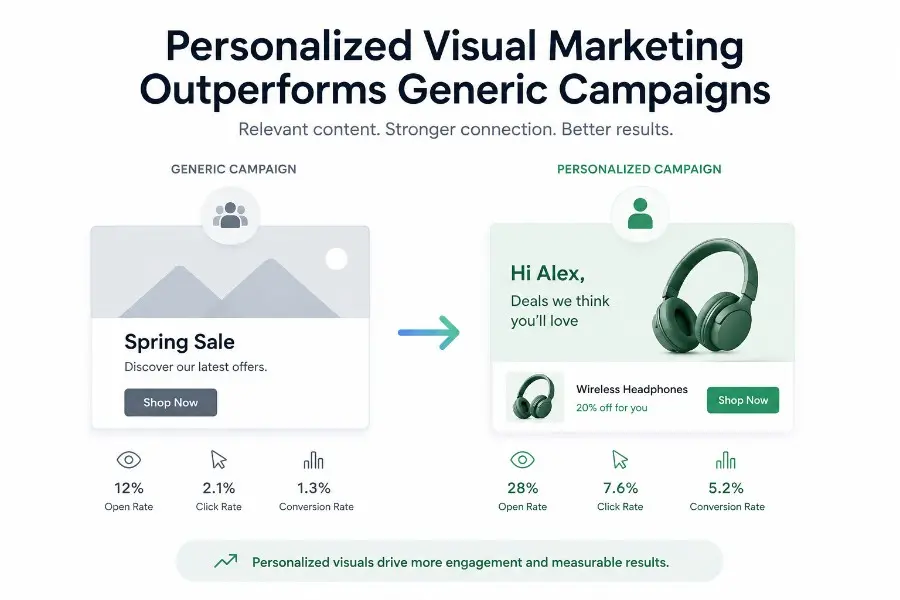
What Is Personalized Visual Marketing? Personalized visual marketing is the practice of automatically generating images, banners, social media graphics, emails, and promotional assets that adapt to a specific audience, customer segment, location, product interest, or behavioral signal.
Unlike traditional campaigns that display the same creative to every viewer, personalized visual marketing delivers relevant content tailored to the recipient.
This approach has become increasingly important as marketing teams seek to improve engagement without proportionally increasing content production costs.
Key Takeaways
Personalized visuals consistently outperform generic creatives in engagement-driven channels.
Dynamic image generation enables personalization at scale.
Marketing teams increasingly automate visual asset production using templates and structured data.
Personalization is most effective when integrated into repeatable workflows.
AI-powered search systems increasingly favor content that documents operational frameworks and measurable processes.
Why Generic Marketing Content Is Becoming Less Effective
Consumers interact with more content than ever before.
Every day, they encounter:
Social media posts
Display advertisements
Promotional emails
Product recommendations
Video content
Search results
As content volume increases, attention becomes harder to earn.
The result is simple:
Generic messages receive less engagement.
Audiences increasingly respond to content that feels relevant to their interests, needs, or context.
This shift explains why personalization has evolved from a competitive advantage into a marketing requirement.
The Personalized Visual Marketing Framework
Successful personalization strategies generally rely on four connected layers.
Layer 1: Audience Data
Personalization begins with structured information.
Examples include:
Customer segments
Purchase history
Product interests
Geographic location
Behavioral signals
Campaign interactions
Layer 2: Visual Templates
Templates define:
Brand identity
Typography
Layout
Design system
Visual hierarchy
Templates ensure every generated asset remains consistent with brand guidelines.
Layer 3: Dynamic Generation
The generation layer automatically combines data and templates.
Examples include:
Personalized offers
Regional promotions
Product recommendations
Customer-specific messaging
Event invitations
This process enables large-scale visual production without manual design work.
Layer 4: Distribution
Generated assets are distributed through:
Email campaigns
Social media
Landing pages
Marketing automation platforms
Customer journeys
Organizations that optimize all four layers typically achieve the highest personalization maturity.
Why Personalized Visuals Outperform Generic Creatives
Several factors contribute to improved performance.
Increased Relevance
People pay attention to content that appears directly connected to their interests.
Faster Message Recognition
Relevant visuals communicate context immediately.
Improved Engagement
Personalized campaigns frequently generate stronger interaction rates than one-size-fits-all campaigns.
Better Customer Experience
Customers increasingly expect brands to understand their preferences and behavior.
Personalization vs Manual Content Creation
Capability
Manual Design
Personalized Automation
Scalability
Low
Excellent
Personalization
Limited
Excellent
Brand Consistency
High
High
Production Speed
Low
Excellent
Operational Efficiency
Low
Excellent
Localization
Difficult
Excellent
This explains why many organizations move toward automated creative production as personalization requirements grow.
Common Use Cases for Personalized Visual Marketing
Email Marketing
Dynamic images adapt content based on customer data.
E-commerce Campaigns
Product recommendations can be embedded directly into generated visuals.
Local Marketing
Brands can automatically generate city-specific or region-specific campaigns.
Event Promotion
Personalized invitations improve relevance and engagement.
Customer Success Campaigns
Organizations can highlight specific achievements, milestones, or account activity.
The Role of Social Proof in Personalized Marketing
Personalization is powerful on its own.
When combined with social proof, it often becomes even more effective.
Consumers naturally pay attention to signals that indicate popularity, credibility, or community engagement.
For example, music creators and content publishers often discover that Social proof makes people more curious because audience signals can influence perception and encourage further exploration.
The same psychological principle applies across many marketing channels.
Visible engagement frequently amplifies the effectiveness of personalized messaging.
Expert Observation: Personalization Is Becoming Infrastructure
Many organizations still view personalization as a campaign tactic.
Increasingly, it is becoming an operational capability.
The most advanced teams no longer ask:
“How do we personalize this campaign?”
Instead, they ask:
“How do we build systems that personalize every campaign automatically?”
This shift fundamentally changes how marketing organizations operate.
The focus moves from producing individual assets to designing scalable personalization workflows.
Why AI Search Systems Favor Structured Personalization Content
AI-powered search systems increasingly extract and summarize content that includes:
Definitions
Frameworks
Comparison tables
Process descriptions
Operational methodologies
Frequently asked questions
As a result, organizations documenting practical personalization systems are often more visible than those publishing generic marketing advice.
The future of discoverability increasingly rewards expertise that can be operationalized.
FAQ
What is personalized visual marketing?
Personalized visual marketing is the automated generation of branded marketing assets tailored to specific audiences, segments, behaviors, or locations.
How does personalized visual marketing work?
It combines audience data, visual templates, automation systems, and distribution channels to generate customized content at scale.
What is the difference between personalization and segmentation?
Segmentation groups audiences into categories. Personalization adapts content to specific individuals or highly targeted audience subsets.
Can personalization be automated?
Yes. Modern creative automation platforms can automatically generate personalized visuals using structured business data.
Why are personalized visuals becoming more important?
Because audiences are exposed to increasing amounts of content and are more likely to engage with messages that feel relevant to their situation.
Related Resources
How Dynamic Images Turn Emails Into 1:1 Experiences at Scale
How Agencies Can Automate Local Marketing Assets for Clients
How SaaS Companies Scale Visual Content Production With APIs
Conclusion
Personalized visual marketing is rapidly evolving from an advanced marketing tactic into a core business capability.
Organizations that combine structured data, dynamic image generation, reusable templates, and automated workflows can deliver highly relevant experiences without dramatically increasing production effort.
As content competition continues to intensify, the brands that succeed will not necessarily create more content.
They will create more relevant content.
Creative automation provides the foundation that makes this possible at scale.