When companies strive to optimize their efforts on Instagram, they focus on publishing content faster, although it’s not the only thing to consider. Business owners spend a lot on scheduling tools, AI-powered design workflows, content calendars, and many more.
However, they don’t take into account the communication they have under these posts, Instagram Stories, and Reels. This might be time-consuming for teams, especially when a brand is fast-growing. Manual handling of comments and questions might lead to inconsistency, late replies, and frustration with a certain business.
Instagram marketing automation isn’t just about your visual content production, which is fast and consistent. It also includes managing conversations generated by those posts. If you want to grow faster and have a loyal audience, you should be able to set both on autopilot.
In this article, we’ll show you how a two-layer Instagram automation stack works in real life. We’ll also review each of them and unveil how they connect.
Scaling Your Visual Content
For the majority of brands out there, visual content is the main tool contributing to Instagram growth. Whether you create a new campaign, prepare a product launch, plan a seasonal promotion, or share an educational post, you need new creative assets. During this time, many business owners still create one-off designs. Each post, ad, or story is designed manually, which takes a lot of time from your team. It might be fine when you have a small customer base, but it gets complicated once business starts growing.
It’s not even about time but scalability. When a company runs multiple campaigns, targets different audience segments, or creates posts for several communication channels, it needs dozens or even hundreds of visual pieces monthly. That’s why this simply becomes impractical. Creating every visual asset manually also leads to inconsistencies and takes longer for campaigns to be ready.
This is where visual content automation comes in handy. Tools like Pixelixe are created to transform design from a manual task into a repeatable process. Brands can focus on creating several content variations instead of doing it one by one manually. The workflow is straightforward. You start by creating a branded template with your brand identity and then proceed to dynamic data sources like campaign details, spreadsheets, API integrations, etc.
Let’s imagine that an e-commerce business has a seasonal sale. The company can automatically generate Instagram posts, Stories, banners, and email graphics while ensuring branding consistency with a reusable template. This way, the brand has a scalable content system instead of isolated projects. Team members can prioritize optimizing campaigns and trying new methods rather than building new assets from scratch all the time.
However, visual content publishing is the beginning of a long process. Once your posts start generating interest, they will also bring engagement. This is your new challenge. You need to handle comments under your posts, answer DMs, and provide information. This is the stage where engagement automation is a must, especially when you have lots of comments. It’s a crucial layer of a successful Instagram marketing system.
Automating What the Post Triggers
Publishing great visual content is an important part of Instagram growth for every business. However, it is only half of a successful strategy. The other half is in managing the interactions related to the posts you publish. This is a challenging task because it affects the opportunities you can have.
When the number of posts and audience reach increases, it becomes more difficult for businesses to manage all the comments and DMs manually. If a post is effective, it can bring hundreds of comments, questions regarding the product and its pricing, etc. Company owners can miss potential customers and revenue while handling all of the requests without special tools.
This is the point where engagement automation is the second layer of a successful Instagram marketing strategy. By turning comments and DMs into automated conversion flows, businesses ensure that every comment gets their attention. Services like SendPulse allow business owners to design Instagram chatbots for handling every chat on autopilot while ensuring a consistent customer experience. Brands can create different chatbots to answer FAQs, provide information about product availability, pricing, features, make appointments, register people for events, etc. There’s also a human handoff option for more complex inquiries.
Businesses can automate public engagement, too. You can show your appreciation to users and continue conversations with them after replying to their comments under posts. With automated comment response workflows, businesses have the opportunity to acknowledge engagement and guide users. It helps remain responsive even when brand reps are busy or during non-working hours.
Now it’s time to figure out how these two work together. Only after this, you’ll be able to design a fully automated Instagram workflow bringing new customers.
How the Two Layers Connect in Practice
You can reap the real benefits of Instagram automation when you treat content creation and audience engagement as a part of a system. In this section, we’ll provide you with an example to make everything clear. This is a scenario of a lead generation campaign promoting a 7-day online yoga teacher training course. We’ll uncover it step by step.
1. Create the promotional content with Pixelixe
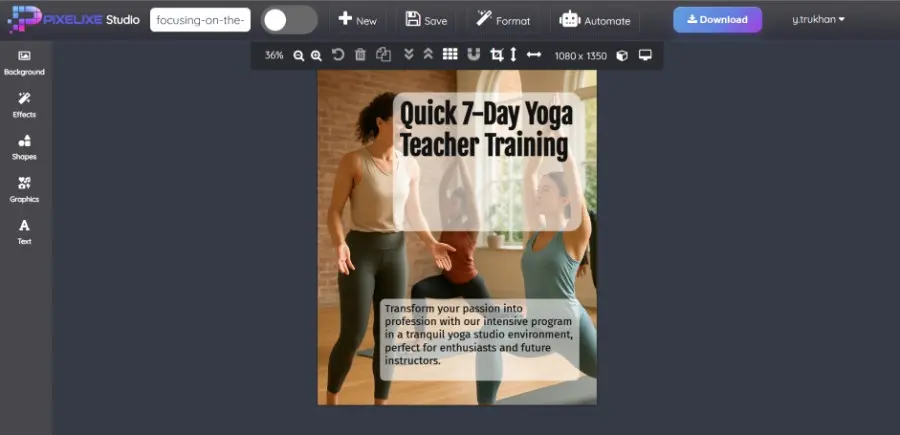
First of all, the yoga teacher takes advantage of Pixelixe to create a branded Instagram graphic from a pre-built template. The platform provides all the necessary tools for this. It allows this person to create an approved branded layout and turn it into a template. A yoga teacher later uses it for campaigns, catalogs, lifecycle programs, and localized launches. This person creates a design that totally matches the branding and includes a clear call-to-action button: “Want to join our 7-day yoga teacher training? Comment JOIN below.”
If the team decides to make some changes to the template, it can be done easily with the platform. Different variations for specific audience segments, offers, or promotions are possible.
2. Publish and attract engagement
After the post becomes available online, it starts generating engagement, including likes, Story replies, comments, etc. However, the work doesn’t end after publishing a post. The team needs to handle all the comments and DMs manually. The yoga training team should keep an eye on the post, identify qualifying comments, and manually send direct messages to every person who interacted with the post. As soon as the number of users increases, it becomes difficult to handle.
3. A comment triggers a DM flow
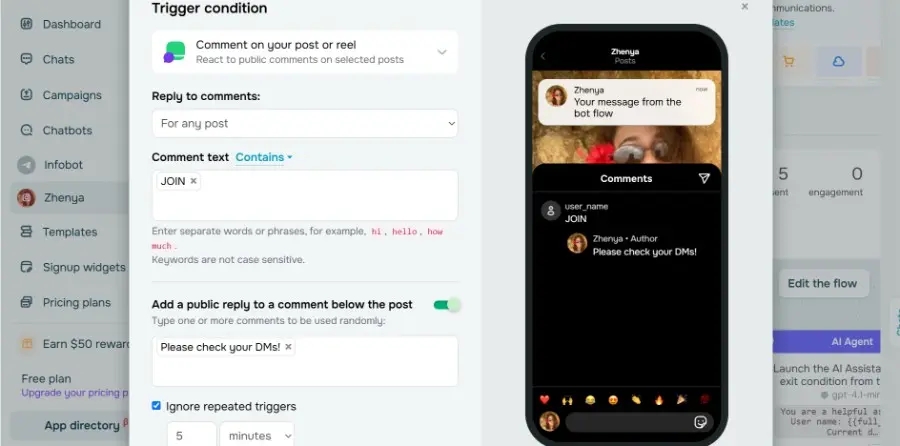
Instead of manual handling of all the comments, the team uses SendPulse. The platform monitors the post for the keyword “JOIN.” Once a user comments and includes the keyword “JOIN,” an automated workflow is triggered. This user instantly receives a DM message: “Thanks for your interest. Here’s a registration link to our 7-Day Yoga Teacher Training 2026. We would also like to ask about your primary goal.” It feels personal and allows the team to better understand participants and their goals.
4. The chatbot qualifies the lead
The communication continues using Instagram DMs. The chatbot asks several questions that allow you to figure out whether prospects are really interested in joining this training. These are questions about: previous yoga experience, teacher experience, and whether the person needs a personalized approach. Using the answers, SendPulse groups leads to defining further steps.
5. High-intent prospects are routed to sales
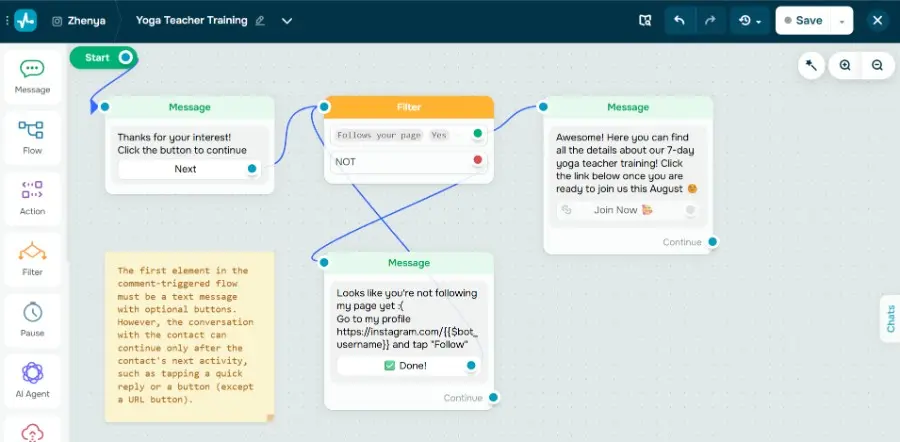
When a prospect shows a high intent for participating in a course, the bot can perform one of these actions: share a booking link, schedule a consultation, transfer the conversation to a human team member, or add the lead to the company’s CRM. At the same time, less qualified leads receive educational content, including the details of the course (yoga teachers, schedule, valuable insights, asanas, etc).
To conclude, we’ll show you the complete two-layer workflow:
Pixelixe designs the branded promotional post or ad;
The post or ad goes online on Instagram;
A user comments and includes the keyword “JOIN”;
SendPulse delivers a DM;
The bot qualifies this prospect;
Sales reps get contact data of leads with high intent.
Knowing how the layers connect raises the next question: what to automate and what to keep human.
What to Automate vs. What to Keep Human
Although in this article we explore two types of automation for Instagram, it doesn’t necessarily mean that you should automate everything. It’s still crucial to stay human in specific areas. In this section, we’ll discuss this in more detail. This way, you’ll be able to build a powerful Instagram strategy that converts more users into customers.
The first thing we should mention is the areas your team needs to automate to improve productivity and customer satisfaction. They include FAQ responses, lead magnet delivery, appointment booking, comment-triggered DMs, lead qualification, routine support requests, and repetitive content production. These are simple tasks that don’t require a specific approach or human involvement. By creating an Instagram chatbot, you’ll be able to respond around the clock despite working hours and time zones. This is essential for improving customer experience and engagement. You also prevent prospects from choosing other businesses over your brand.
When customers have more complex issues, it’s a must for you to add a human handoff option. You should also take into account that it should be easily accessible. Avoid taking customers hours to reach out to your human customer support agents. It will prevent frustration. We recommend keeping human in such areas: complex sales discussions, sensitive customer issues, relationship building, strategic partnerships, influencer negotiations, crisis communication, and others.
Remember, automation brings real results when you let special tools handle repetitive tasks and allow your team to prioritize more complex, high-value interactions. If you have the same issue emerging all over again, consider automating it. When the situation is unique, requiring empathy, creativity, or negotiation, always route this conversation to your human specialist. It’s best for your customer and business reputation.
Conclusion
You can hear business owners talking a lot about publishing content and ways of doing it on autopilot. However, they often miss the fact that, besides creating good content and sharing it at the right time, they should also ensure proper communication. This is where many brands fail. Usually, when they have a lot of users commenting on their posts and asking about products, managers can’t deliver timely and relevant responses. That’s where engagement automation is a must.
The balance between content and engagement automation makes a difference for your business. They allow growth and customer satisfaction if you do everything right. Successful brands usually use a two-layer automation stack. You can take care of visual production with Pixelixe while SendPulse takes care of comments, DMs, and chatbot workflows. This makes a huge difference for your team as well because they can finally focus on more urgent tasks requiring human interaction. If you are interested in discovering engagement automation closer, we invite you to explore our article titled “Instagram Automation: Tools, Use Cases & Best Practices [2026].” It will help you get started properly.