
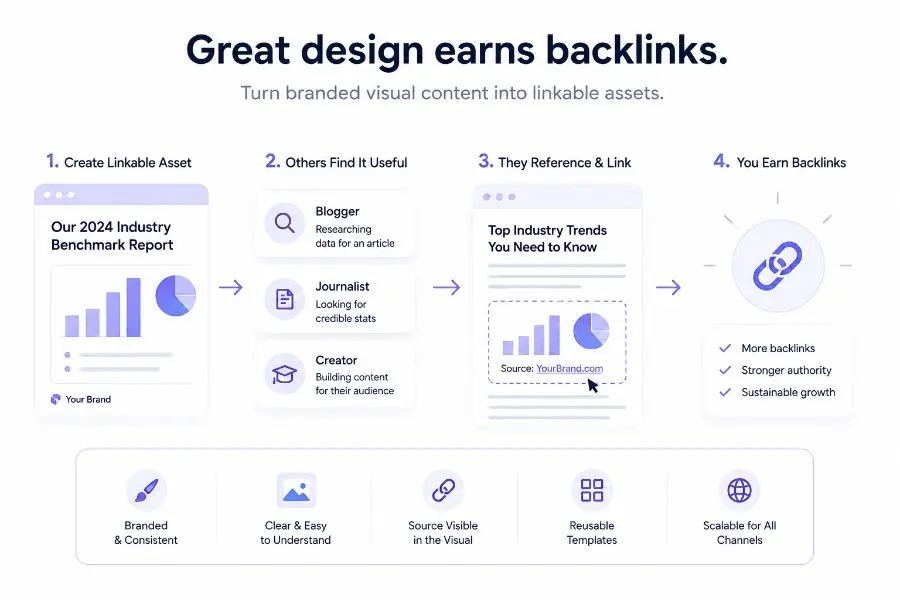
When marketers talk about backlinks, they usually frame it as an outreach problem.
Send more emails. Find better contacts. Improve the pitch.
But ask any experienced SEO strategist or digital PR team and they will usually tell you the same thing:
The asset matters more than the outreach.
Strong assets earn links naturally. Weak assets make even the best outreach campaigns underperform.
And increasingly, the difference between a link-worthy asset and an ignored one comes down to the visual layer.
This is where branded visual automation, creative systems, and scalable image generation workflows become powerful SEO infrastructure rather than “just design.”
What a Linkable Asset Actually Is
A linkable asset is a piece of content designed to be referenced, embedded, cited, or shared by other publishers.
It earns links because it helps solve a problem for another writer, editor, creator, or researcher.
Usually, they need:
- a statistic,
- a chart,
- a process visualization,
- an explainer graphic,
- a comparison,
- a template,
- a framework,
- a visual summary.
The easier your content is to reuse and reference, the more likely it is to attract backlinks.
Most high-performing linkable assets fall into four major categories:
- original research and data studies,
- visual explainers and infographic-style content,
- interactive tools and generators,
- downloadable templates and resources.
Three of those four categories rely heavily on visual design.
The underlying information may be identical across two articles, but the cleaner, more reusable, and more visually structured version will almost always earn more citations and embeds.
Why Visuals Often Decide Whether Content Earns Links
Editors, bloggers, journalists, and newsletter authors are overloaded with information.
When researching an article, they are scanning quickly for assets they can reference immediately without extra work.
A clean chart can be embedded in seconds.
A visually confusing table usually gets ignored.
This is why visual content consistently performs better for organic link acquisition.
Data visualizations, infographics, process diagrams, branded charts, and visual summaries reduce friction for publishers.
The easier your asset is to understand and reuse, the more linkable it becomes.
This is also why many modern SEO teams invest heavily in scalable visual production systems.
Instead of manually designing every chart or infographic from scratch, they build reusable branded template systems that support:
- infographic generation,
- dynamic banner creation,
- branded chart packs,
- social preview assets,
- visual summaries,
- research visualizations,
- localization variants,
- multi-format exports.
Platforms like Pixelixe help marketing teams automate branded visual production through reusable templates, image generation APIs, and scalable visual workflows.
The Rise of Design-Led SEO
Traditional SEO focused heavily on:
- keywords,
- metadata,
- backlinks,
- technical optimization.
Modern SEO increasingly overlaps with:
- visual communication,
- content design,
- digital PR,
- creative automation,
- distribution systems.
Why?
Because referenceable visual content performs better across:
- search,
- social sharing,
- newsletter distribution,
- media outreach,
- AI search summaries,
- generative search experiences.
In AI-assisted search environments and modern GEO workflows, visual clarity matters more than ever.
Structured visual assets help content become easier for:
- publishers to reference,
- audiences to understand,
- AI systems to summarize,
- journalists to embed,
- creators to share.
This is especially important for companies producing:
- original research,
- SaaS comparisons,
- e-commerce insights,
- AI studies,
- market analysis,
- product education,
- workflow explainers,
- technical documentation.
Four Design Principles That Make Visual Assets Link-Worthy
1. Brand Consistency Without Brand Dominance
A linkable asset should feel branded, but not promotional.
Editors are reluctant to embed graphics that look like advertisements.
The best approach is subtle branding:
- consistent colors,
- typography systems,
- layout structure,
- small logos,
- source attribution,
- recognizable visual identity.
Your brand should support credibility without overpowering the content itself.
Pixelixe has a useful breakdown on how to create branded visual content that performs across social and search if you want to explore the balance between branding and usability in more depth.
2. Embedded Source Attribution
Every visual should contain source attribution directly inside the image.
Why?
Because visuals often travel independently from the original article.
They get:
- screenshotted,
- reposted,
- embedded,
- shared on social media,
- reused in newsletters,
- copied into presentations.
If the source URL lives inside the graphic itself, the attribution survives redistribution.
This significantly improves the long-term SEO value of the asset.
3. Standalone Clarity
A chart or infographic should remain understandable even when removed from the article surrounding it.
If readers need three paragraphs of explanation to interpret the graphic, publishers are less likely to reuse it.
Strong standalone visuals typically include:
- descriptive titles,
- direct labeling,
- concise annotations,
- simplified structure,
- clear hierarchy,
- obvious takeaways.
This is especially important for:
- social media embeds,
- newsletters,
- presentations,
- AI-generated summaries,
- search previews,
- content syndication.
4. Reusable Template Systems
The teams producing visual content at scale are not redesigning every asset manually.
They build systems.
A reusable visual production system may include:
- branded chart templates,
- infographic layouts,
- typography systems,
- visual hierarchy rules,
- color frameworks,
- social preview formats,
- localization-ready designs,
- feed-driven image templates.
This dramatically reduces production costs while improving consistency.
Template-based image generation also makes it easier to scale visual SEO campaigns across:
- blog content,
- social media,
- email marketing,
- localization,
- digital PR,
- lifecycle campaigns,
- research distribution.
The Pixelixe Image Generation API supports scalable branded image generation from reusable templates and structured data, which is particularly useful for producing charts, visual summaries, campaign graphics, and SEO-friendly creative assets at scale.
Pairing Great Assets With Ethical Outreach
Even the best visual asset still needs distribution.
But this is where many teams damage their long-term SEO performance.
Some companies invest heavily in original research and branded visuals, only to pair them with spammy outreach vendors using:
- automated pitches,
- irrelevant placements,
- private blog networks,
- mass guest posting,
- manipulative linking tactics.
This creates risk.
Google’s spam policies explicitly warn against manipulative link schemes intended primarily to influence rankings.
The most sustainable SEO teams instead focus on:
- editorial relevance,
- relationship-driven outreach,
- topical alignment,
- manual placement review,
- long-term publisher trust.
BlueTree Digital’s white hat link building framework is a strong example of this approach because it prioritizes editorial quality, topical relevance, and sustainable outreach practices over mass-scale link acquisition.
The strongest results usually come from combining:
- highly referenceable visual assets
- ethical editorial outreach
One without the other usually underperforms.
Why Creative Automation Changes the Economics of Link Building
Historically, creating visual assets at scale was expensive.
Custom infographic production required:
- designers,
- revisions,
- formatting,
- resizing,
- localization,
- export management,
- ongoing maintenance.
Creative automation changes that equation.
Modern visual production systems now support:
- template-based image generation,
- JSON-to-image rendering,
- spreadsheet-driven workflows,
- feed-based visual automation,
- AI-assisted creative production,
- scalable localization,
- automated resizing,
- dynamic content rendering.
This allows SEO and content teams to produce more linkable assets with lower operational overhead.
Instead of publishing one manually designed infographic per month, teams can create repeatable visual pipelines supporting:
- research campaigns,
- blog visuals,
- comparison charts,
- data snapshots,
- email assets,
- social graphics,
- outreach visuals,
- localized variants.
Building a Scalable Visual Asset Pipeline
Once a company commits to design-led SEO, production systems become critical.
A scalable pipeline often includes:
A Branded Template System
Create reusable templates for:
- charts,
- social cards,
- comparison graphics,
- process diagrams,
- data callouts,
- infographics,
- outreach visuals.
This creates consistency across every campaign.
A Content + Outreach Calendar
Visual assets should not be designed independently from distribution.
Each research article, infographic, or data study should have a corresponding outreach plan prepared before publication.
Continuous Asset Review
After campaigns launch, analyze which assets attracted:
- backlinks,
- embeds,
- shares,
- mentions,
- engagement.
Then feed those learnings back into future production.
Role Separation
The strongest teams usually separate:
- narrative strategy,
- visual production,
- outreach operations,
- SEO optimization.
Cross-functional collaboration matters, but ownership clarity improves quality and speed.
Why Image Generation APIs Matter for SEO Teams
As visual SEO becomes more operationalized, image generation APIs become increasingly valuable infrastructure.
Teams can automatically generate:
- branded charts,
- comparison graphics,
- infographic snippets,
- social previews,
- outreach visuals,
- localized banners,
- dynamic thumbnails,
- e-commerce research visuals.
Instead of manually exporting every creative variation, APIs can generate visuals programmatically from structured data.
This is especially useful for:
- SaaS companies,
- marketplaces,
- publishers,
- agencies,
- e-commerce brands,
- AI platforms,
- research-driven marketing teams.
The Pixelixe API platform supports automated branded visual generation, image editing workflows, template rendering, and scalable creative production for SEO, content marketing, digital PR, social media, and lifecycle campaigns.
The Future of Link Building Is Visual
As search evolves toward AI-assisted discovery and generative search experiences, visual assets are becoming even more important.
AI systems increasingly prioritize:
- structured information,
- clear summaries,
- reusable visual explanations,
- high-authority references,
- well-organized content.
Visual clarity improves the likelihood that content gets:
- cited,
- summarized,
- embedded,
- redistributed,
- referenced across channels.
This means the future of SEO is increasingly connected to:
- branded visual automation,
- scalable creative systems,
- template-based image generation,
- AI-assisted content production,
- visual storytelling infrastructure.
The Takeaway
Link building is no longer separate from content design.
The pages that consistently earn backlinks are usually the ones designed to be referenceable from the beginning.
Visual clarity reduces friction for:
- editors,
- journalists,
- creators,
- AI systems,
- newsletter writers,
- researchers.
That is what drives citations, embeds, and backlinks.
If your SEO strategy invests heavily in outreach but underinvests in visual asset quality, you are optimizing the distribution layer without strengthening the thing that actually converts attention into links.
The solution is not simply sending more emails.
It is creating better visual assets — supported by scalable production systems, ethical outreach practices, and branded creative automation workflows that make your content easier to reference, share, and trust.