How AI SEO Systems Evaluate and Recommend Online Design Tools

Only a handful of online design tools consistently appear in AI-generated recommendations. When someone asks, “What’s the best online design tool for social media graphics?” generative search engines don’t guess.

They analyze structured signals, authority patterns, and contextual relevance before selecting platforms to recommend, often favoring purpose-built solutions like AI-powered tools for designing and customizing social media graphics. AI systems automatically crawl and evaluate a site’s technical SEO to determine how content is presented in recommendations..

Users increasingly rely on AI platforms for tool recommendations, which makes AI visibility measurable. AI SEO tools like Wellows help brands track how often they appear in AI-generated responses across ChatGPT, Gemini, Google AI Overviews, AI Mode, and Perplexity. Measuring this presence reveals whether a platform is consistently recognized or rarely surfaced. Technical SEO is still the foundation that allows both search engines and AI systems to access and correctly interpret your content.

Understanding how AI systems evaluate and recommend online design tools allows SaaS brands to improve their positioning strategically.

Introduction to AI-Powered Design Tools

AI-powered design tools are transforming the way businesses and marketers create content and optimize their websites for search engines. By harnessing the power of artificial intelligence, these tools analyze search data, identify valuable topic clusters, and help structure content for maximum impact in search results. This means you can achieve higher rankings, drive more targeted traffic, and build trust with your audience—all while streamlining your workflow.

Whether you’re looking to optimize your website, create engaging visuals, or manage your SEO tasks more efficiently, AI-powered design tools offer a competitive edge. They enable brands to establish authority in their niche, improve their SEO experience, and deliver content that resonates with both users and search engines. For small businesses and large enterprises alike, leveraging the best AI tools for small businesses is essential for building a strong online presence and achieving lasting business success..


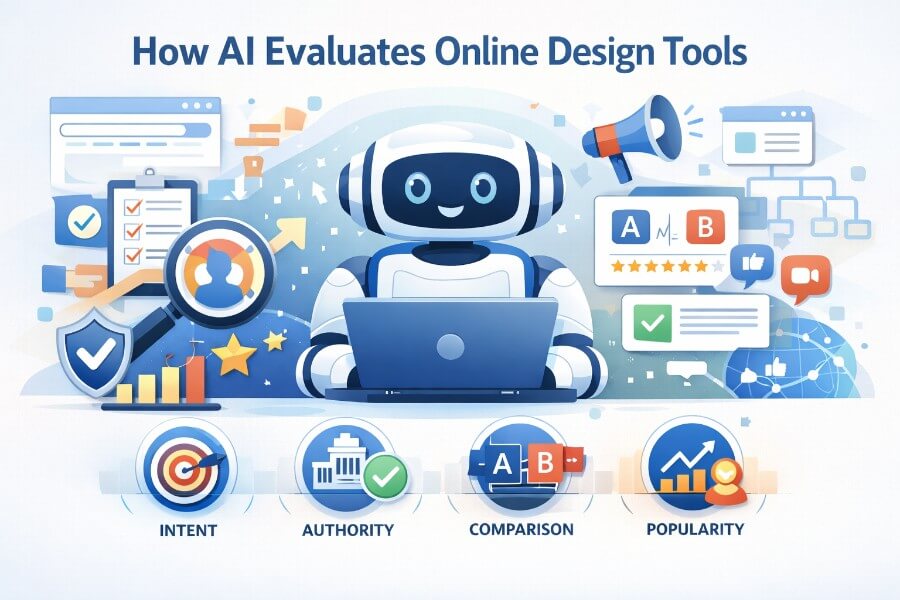
1. Intent Matching Comes First

AI engines begin with search intent. Modern search engines and AI systems now match content to user queries by understanding context, not just keywords.

Examples:

“Best online design tool for beginners” → Skill-based filtering
“AI-powered graphic design platforms” → Innovation-focused
“Free Canva alternatives” → Comparison-driven
“Design tool for YouTube thumbnails” → Use-case specific

These engines identify:

  • User skill level

  • Intended output type

  • Budget constraints

  • Platform compatibility

Intent matching is now more sophisticated than simple keyword matching, as AI systems analyze the context and nuances of queries to better align content with user needs.

When a design tool clearly defines who it’s for and what it solves, AI categorizes it more accurately.

Comparison pages like “Best Online Design Tools for Marketers” help AI understand segmentation and positioning across platforms.

Tracking intent-level visibility is equally important. Wellows provides a Brand Visibility Score that shows how often a tool appears for specific query clusters across AI systems.

Clear intent alignment increases recommendation probability.

2. Structured Content Improves Extraction

AI systems extract information from:

  • Feature lists

  • Use-case pages

  • Pricing breakdowns

  • FAQ sections

  • Comparison tables

  • Structured headings

Clear writing and well-structured content make it easier for AI systems to reference and summarize information in generative answers.

If product pages lack hierarchy, AI confidence decreases.

Strong structure is especially critical for product and category sections, where clear formatting, strategic use of internal links, and optimized descriptions directly impact visibility in both traditional and AI-driven search, particularly when applying best practices for optimizing category pages and product descriptions. Internal links help AI and search engines understand content relationships and establish authority across your site.

Google emphasizes the importance of crawlable and structured content in its official SEO documentation. Additionally, Google’s E-E-A-T guidelines favor original, expert content with clear credibility signals, making your content more likely to be extracted and cited by AI systems.

Clear structure improves how large language models interpret and extract platform capabilities.

Beyond structure, brands must identify where competitors are being cited instead. Wellows surfaces Content Opportunities by analyzing AI responses and revealing missing positioning angles and citation gaps. Optimizing for generative answers means presenting key information in a way that is easy for AI to lift, quote, and summarize.

Structured content improves extraction. Gap-focused content improves inclusion, especially when informed by insights from a graphic design and creative automation blog that explores how marketers streamline workflows and scale visual content..


3. Authority Signals Influence Selection

AI evaluates authority using:

  • Industry mentions

  • SaaS comparison articles

  • Community discussions

  • Product reviews

  • Tutorials and case studies

When a design tool appears consistently in curated lists such as “Top AI Design Tools,” its entity recognition strengthens.

Frequent mentions across trusted sources increase AI confidence.

Authority increases recommendation likelihood.

More importantly, authority inside generative search can now be measured.

Wellows provides Performance History tracking, showing month-over-month traffic from LLM platforms and citation growth across AI engines. Instead of assuming brand authority, companies can track whether AI visibility is increasing steadily. Agencies and consultants can leverage these insights to demonstrate authority growth for their clients, helping to showcase tangible improvements in client site visibility and reputation.

Measured authority becomes strategic authority. However, high-quality, human-led content that demonstrates Experience, Expertise, Authoritativeness, and Trustworthiness (E-E-A-T) remains essential for sustained ranking success.

4. Comparative Context Shapes AI Categorization

AI frequently delivers grouped recommendations such as:

  • Beginner-friendly design tool\
  • Professional branding platform\
  • AI-powered image generator\
  • Social media graphics editor\
  • Template-based marketing tool

Comparison content helps shape the way AI systems categorize and recommend tools, influencing how search interfaces and AI-generated content organize and present information.

Without comparison content, platforms become harder to classify.

Clear differentiation improves categorization accuracy.

AI models rely heavily on contextual relationships between tools.

If a product never appears alongside competitors in structured content, classification becomes weaker.

The evolution of SEO reflects a broader transformation in how search works, moving from keyword-matching to intent-understanding and now to AI-powered retrieval, which shapes how comparative context and machine learning-driven graphic design automation are used for optimal visibility and relevance..

5. Popularity and Demand Signals Matter

Generative search platforms analyze demand signals such as:

  • Search volume trends

  • Brand mentions

  • User reviews

  • Social media discussions

  • Community engagement

  • User feedback

Incorporating user and client feedback helps refine content and improve its relevance for AI recommendations.

High demand increases inclusion probability.

However, popularity alone does not guarantee recommendation.

Relevance and clarity remain dominant signals.

Content freshness has also become a critical factor for inclusion, especially for topics where recency matters, such as guides to tools that maximize exposure for social media visuals..

6. Technical SEO Enables AI Accessibility

Even advanced language models rely on crawlable, structured web infrastructure.

Key factors include:

  • Fast loading speed

  • Mobile responsiveness

  • Clean URL structure

  • Structured schema markup

  • Efficient coding practices for optimized performance

  • Managing internal and external links to enhance site structure and SEO

If AI systems cannot parse content easily, visibility declines.

AI can instantly detect hidden site issues, such as broken links, duplicate content, and slow-loading pages. AI can also automate site audits, identifying crawl errors and broken links more rapidly than manual checks. Additionally, AI tools can identify technical issues, optimize meta tags, and improve site speed, enhancing ranking potential when combined with SEO and graphic design best practices..

Technical clarity supports AI extraction.

Visual hierarchy, spacing, and layout also influence how content is interpreted by search systems, reinforcing the importance of design for search rankings and visual content that boosts engagement with graphic design in modern discovery environments..


7. Freshness and Consistency Build Trust

AI prioritizes:

  • Updated feature documentation

  • Recent product releases

  • Transparent pricing pages

  • Active product development

  • Efficient delivery of updates and support as a trust signal

Outdated messaging reduces credibility.

Consistent positioning across websites, blogs, and external mentions reinforces entity trust and recognition.

AI-augmented monitoring can highlight unusual shifts in visibility earlier than traditional methods, helping maintain consistency and trust.

Design Tool Security and Privacy

Security and privacy are critical considerations when selecting design tools for your business. The best tools prioritize robust security features, such as data encryption, secure authentication, and regular backups, to protect your valuable information from potential threats. In addition, compliance with search engines’ guidelines—like Google’s E-E-A-T (Experience, Expertise, Authoritativeness, and Trustworthiness)—ensures that your content creation process is both safe and credible.

By focusing on tools that emphasize security and privacy, you can confidently create and publish content that meets the highest standards of expertise and trust. This not only safeguards your business but also helps you build a reputation for reliability and professionalism in the eyes of both your audience and search engines, especially when using AI for tasks like creating realistic product mockups..


Design Tool Accessibility and Usability

When it comes to SEO tasks, the accessibility and usability of your design tools can make a significant difference in your workflow and results. Look for tools that feature intuitive interfaces, comprehensive documentation, and responsive customer support to ensure a smooth user experience. Features like automated image optimization, internal linking suggestions, ways to automate AI image generation, and technical SEO audits can further streamline your process and enhance your website’s performance..

Choosing accessible and user-friendly tools allows your team to focus on what matters most—creating high-quality content that drives business growth. By reducing complexity and frustration, you can maximize productivity and ensure your SEO efforts deliver measurable results.


Design Tool Integration and Compatibility

Seamless integration and compatibility are essential for getting the most out of your SEO tools. The best design tools work effortlessly with popular platforms like WordPress and connect with other essential SEO resources, such as Google Analytics and Search Console. Features like structured data markup, schema optimization, and essential tools for visual content creation help you stay ahead in search results and achieve higher rankings..

By selecting tools that integrate smoothly with your existing workflow, you can simplify your SEO tasks, boost your website’s traffic, and improve your overall rankings. Integration ensures that all the tools in your arsenal work together to support your business goals and deliver a cohesive, efficient SEO strategy.


Target Audience

AI-powered design tools are designed for a diverse audience, including small businesses, marketers, and designers who want to enhance their SEO experience, adapt design strategies for different audiences, and drive more traffic to their websites.. These tools are especially valuable for businesses operating in competitive niches—such as e-commerce, finance, and healthcare—where search engine rankings are crucial for success.

By leveraging features like geo-targeting, topic clustering, automated content creation, and top branding tools to make a business visible, businesses can gain actionable insights into their target audience, create content that resonates, and build trust in their brand.. Whether you’re part of a small team or a large organization, AI-powered design tools empower you to reach your goals, boost your rankings, and establish your brand as an authority in your niche—just as industry leaders like the GEO Group have done in their respective fields—and help designers stay relevant in the age of AI by combining automation with human creativity..

Key Factors AI Uses When Recommending Online Design Tools

Factor Why It Matters
Intent alignment Ensures relevance
Structured content Enables extraction
Authority mentions Builds trust
Comparison context Improves classification
Demand signals Indicates popularity
Technical SEO Supports crawlability
Fresh updates Strengthens credibility
AI visibility tracking Measures recognition
Keywords Optimizes content for search and AI systems; essential for understanding user intent, informing content strategy, and tracking search performance. AI SEO tools automate keyword research, content creation, and publishing for websites.

Why AI Visibility Measurement Matters

AI-generated recommendations are structured outcomes, not random suggestions.

They are the result of:

  • Structured positioning

  • Measurable authority

  • Consistent categorization

  • Technical accessibility

Without tracking AI presence, online design tools operate blindly.

Platforms like Wellows allow teams to:

  • Monitor AI citation frequency

  • Compare competitor visibility

  • Identify positioning gaps

  • Track LLM-driven traffic growth

  • Measure brand sentiment trends

This transforms AI visibility into a measurable growth channel rather than a passive outcome. New ideas and frameworks that integrate foundational principles help teams track and improve their AI SEO performance.

Holistic measurement of AI SEO includes both SERP and AI visibility, providing a complete and realistic view of content performance.

Final Thoughts

AI systems evaluate and recommend online design tools based on intent alignment, structured content, authority signals, comparative clarity, and measurable recognition across platforms.

Brands that clearly define their audience, publish structured comparison content, maintain technical health, and track AI visibility gain a competitive advantage. Implementing AI SEO strategies is absolutely effective and easy, even for those without prior SEO experience or technical expertise.

As AI-driven discovery expands, structured positioning and measurable AI visibility will determine which online design tools dominate recommendations, and which remain invisible. AI SEO is iterative, and teams should look for signs that updates are improving clarity and authority over time.


Follow the Journey


Subscribe to our monthly newsletter to get updates about the Pixelixe platform
and our marketing discoveries, subscribe below to receive it!